 Worldwide Shipping
 Secure Payments
 Free Return
 Local Support
-da0801079a650a2e.jpeg)
17 Year Anniversary Quotes: 110+ Funny, Romantic & Furniture Wishes (2026)
Mar, 12 2026
Orange and black became Halloween's signature colors through ancient Celtic Samhain traditions linking harvest bonfires to the dark spirit realm. This complete history traces their journey from 2,000-year-old rituals to today's spooky celebrations.
According to Cameron Foster's research into Halloween traditions, orange and black became Halloween's signature colors because they represent the ancient Celtic festival of Samhain—harvest bonfires casting orange light against the black void of the year's darkest season. This pairing dates back over 2,000 years, rooted in beliefs about the boundary between the living world and the spirit realm. The combination stuck because it perfectly captures Halloween's dual nature: warmth and fear, celebration and dread, life and death existing side by side. As of autumn 2026, understanding why these specific colors feel so inherently spooky helps explain everything from modern decoration choices to the psychological pull of Halloween itself.
Why orange and black became Halloween colors:
Orange reflects Samhain bonfires and autumn harvest
Black symbolizes death, long nights, and spirits
Celtic tradition marked October 31 as spirit-crossing day
Commercial standardization cemented the pairing by the 1920s
Orange and black became Halloween colors because they directly reflect the Celtic festival of Samhain—the harvest bonfires glowing orange against the encroaching black darkness of winter. The ancient Celts, living primarily in what is now Ireland, Scotland, and Wales, celebrated Samhain on October 31st as the final day before the dark half of the year began. This wasn't merely a seasonal marker—it represented a cosmic transition when the veil between the living and the dead grew thin enough for spirits to cross over.
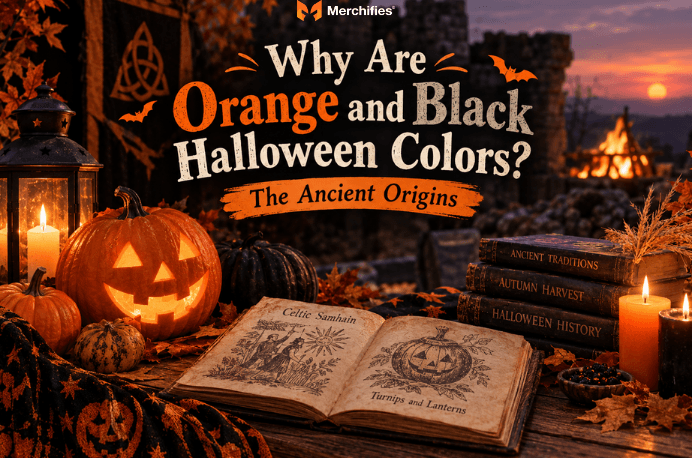
The bonfires served multiple purposes during Samhain celebrations. Communities gathered around these massive fires to burn crops and animal bones as offerings to Celtic deities, creating towering orange flames visible for miles across the darkened countryside. These fires also served a protective function, as the Celts believed the light would ward off malevolent spirits roaming freely during this liminal time. The orange glow became synonymous with safety, community, and the last warmth before winter's grip took hold.
Black represented everything beyond the firelight's reach. The longer nights following Samhain meant darkness dominated daily life—people rose before dawn and returned home after sunset. This physical darkness merged with spiritual darkness in Celtic belief systems. Black symbolized the unknown, the realm of spirits, and the ever-present reality of death that agricultural communities faced each winter. When crops failed or livestock died, families faced genuine mortal danger.
The supernatural element of black extended beyond simple absence of light. Celtic druids wore dark robes during Samhain rituals, and the spirits believed to wander on this night were often described as shadowy figures emerging from the darkness. Banshees, faeries, and ancestral ghosts all belonged to this black realm—respected, feared, and acknowledged through ritual. The orange-and-black combination wasn't chosen arbitrarily; it emerged organically from the lived experience of these autumn celebrations over centuries.
Orange represents the autumn harvest in its most abundant form—pumpkins ripening in fields, leaves turning to flame colors, and the final warmth before winter's cold arrives. This color carries deep agricultural significance that predates written history. For communities dependent on successful harvests, the orange hues of October signaled survival: enough food stored to last until spring, enough preserved goods to sustain families through the darkest months.
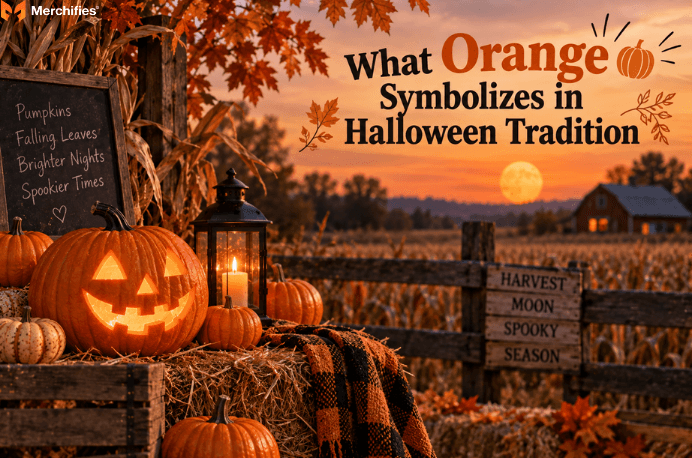
The harvest moon, appearing large and orange on the horizon during autumn months, reinforced this color's connection to the season. Ancient peoples across cultures associated this distinctive lunar appearance with fertility, abundance, and the cyclical nature of life and death. The Celtic celebration of Samhain coincided with the final harvest, making orange the color of both celebration and urgent preparation.
Psychologically, orange triggers specific responses that make it ideal for Halloween's emotional landscape. The color creates feelings of warmth, urgency, and heightened alertness—sensations that contrast sharply with black's cold mystery. Orange demands attention in ways that softer autumn colors like brown or gold do not. This attention-grabbing quality explains why warning signs, safety vests, and cautionary markers often use orange as their primary color.
The jack-o'-lantern tradition transformed orange from abstract symbolism into concrete Halloween imagery. Irish immigrants brought the practice of carving turnips to America in the 19th century, but pumpkins—native to North America and far easier to carve—quickly replaced them. The iconic orange pumpkin, hollowed out and glowing with candlelight, became Halloween's most recognizable symbol by the early 1900s. Today, Americans purchase over 1.5 billion pounds of pumpkins annually, with the vast majority destined for decoration rather than consumption.
Orange's warmth provides essential contrast within Halloween's visual language. Without orange, the holiday would feel purely menacing—all darkness and dread with no counterbalance. The orange glow of pumpkins, autumn leaves, and harvest decorations creates a welcoming element that makes Halloween accessible to children and families rather than purely terrifying.
Black symbolizes death, mourning, and the unknown—the foundational themes that give Halloween its distinctive atmosphere of mystery and fear. This association predates Halloween itself, appearing across virtually every human culture as the color of endings, transitions, and the realm beyond ordinary perception. The Celts who originated Samhain traditions understood black as the color of the Otherworld, where spirits dwelled between incarnations.
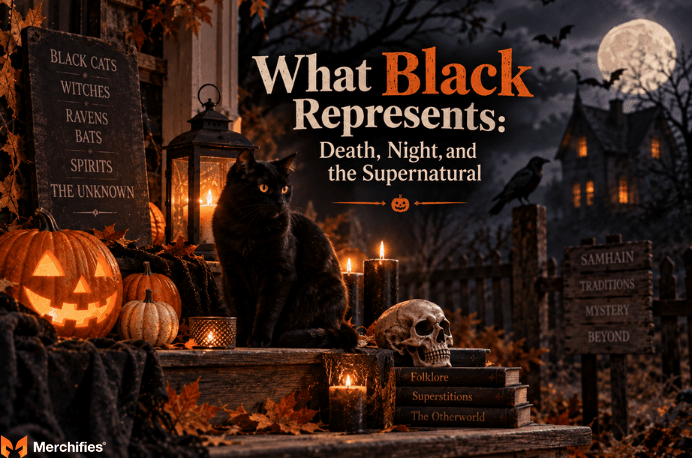
The physical reality of longer nights after October 31st reinforced black's dominance in Halloween symbolism. When Samhain marked the beginning of the dark half of the year, communities experienced dramatically shortened daylight hours. People conducted most activities in darkness, lit only by fire and candlelight. This wasn't metaphorical—black literally surrounded daily existence for months following the Celtic new year.
Black cats, witches' robes, ravens, and bats all reinforce black's supernatural associations within Halloween folklore. These creatures and costumes carry centuries of accumulated meaning, much of it rooted in medieval European superstitions that merged with Celtic traditions. Black cats were believed to be witches' familiars—spiritual companions that aided in magic. Ravens appeared in Celtic mythology as messengers between worlds, while bats emerged from darkness to hunt at twilight, occupying the liminal space between day and night.
Victorian mourning culture, spanning roughly from 1837 to 1901, dramatically strengthened black's association with death in Western consciousness. Queen Victoria's extended mourning for Prince Albert established elaborate death rituals throughout British and American society. Mourning clothes, jet jewelry, black-bordered stationery, and darkened homes became standard practice. This cultural moment coincided with Halloween's evolution from folk tradition to recognized holiday, permanently linking black with death in the popular imagination.
The Victorian era also saw increased interest in spiritualism, séances, and communication with the dead—activities typically conducted in darkened rooms. These practices reinforced black's connection to the supernatural realm, making it the appropriate color for engaging with spirits and otherworldly forces. When Halloween decorations became commercially available in the early 20th century, black naturally dominated alongside harvest orange.
Early 20th-century commercialization transformed orange and black from folk tradition into standardized visual shorthand that instantly signals Halloween. This transition happened rapidly, driven by greeting card companies, candy manufacturers, and decoration producers who recognized Halloween's commercial potential. By the 1920s, seeing orange and black together automatically triggered Halloween associations in American consumers.
Greeting card companies led this standardization effort. Dennison Manufacturing Company published Halloween decoration guides starting in 1909, establishing orange and black as the official color scheme for parties, decorations, and costumes. These guides reached thousands of households, teaching Americans how to properly celebrate Halloween according to commercial standards. Gibson Art Company and Hallmark followed suit, mass-producing Halloween cards featuring orange pumpkins against black backgrounds.
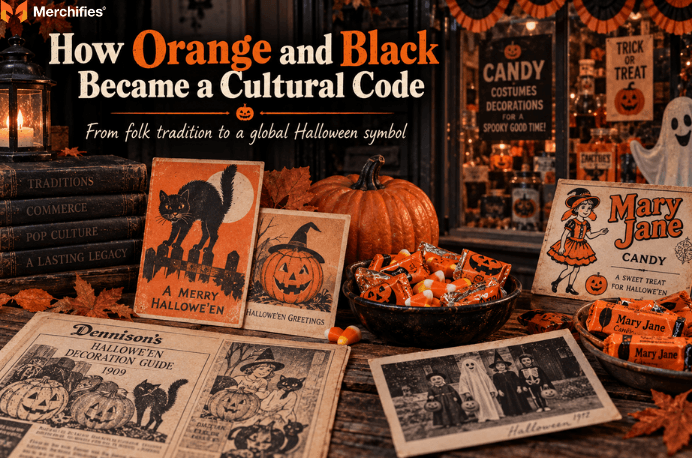
Candy manufacturers amplified the color association by wrapping Halloween-specific products in orange and black packaging. Mary Jane candies, candy corn, and various chocolate bars adopted this palette for their seasonal offerings. When children received treats in orange-and-black wrappers, they absorbed the color code alongside the sugar rush. This consumer conditioning proved remarkably effective—by mid-century, orange and black packaging alone could sell products as Halloween-appropriate.
The comparison to other holiday color schemes illustrates how thoroughly this standardization succeeded. Red and green signal Christmas without any additional context. Pastels indicate Easter. Orange and black mean Halloween—no explanation required. This cultural shorthand developed within roughly three decades, demonstrating how commercial repetition can cement symbolic associations in collective consciousness.
Hollywood horror films from the 1930s onward reinforced the darkness half of this equation while maintaining orange's harvest associations. Universal Pictures' monster movies—Frankenstein, Dracula, The Mummy—established visual conventions for supernatural horror that relied heavily on shadows, darkness, and nighttime settings. When these films appeared on television during October programming blocks, they further cemented black's role in Halloween's visual identity.
The post-World War II suburban expansion created new opportunities for Halloween commercialization. Tract housing developments featured uniform front yards ideal for decoration displays, while baby boom demographics meant millions of children demanding costumes and candy. Manufacturers responded by flooding markets with orange-and-black products at increasingly affordable prices, making elaborate Halloween celebrations accessible to middle-class families nationwide.
Purple joined Halloween's color palette through longstanding associations with magic, witchcraft, and supernatural mystery—historically a color reserved for royalty and the spiritually powerful. While orange and black remain the core combination, modern Halloween embraces a broader spectrum that each carries its own symbolic weight and historical significance.
Purple's connection to magic stems from its rarity in nature and historical expense. The dye required to produce purple cloth—extracted from sea snails—made it prohibitively expensive for common people throughout most of history. Only royalty and religious figures could afford purple garments, creating associations with power, mystery, and realms beyond ordinary experience. Witches and sorcerers in folklore often wore purple to signify their supernatural abilities, making the color a natural addition to Halloween's visual vocabulary.
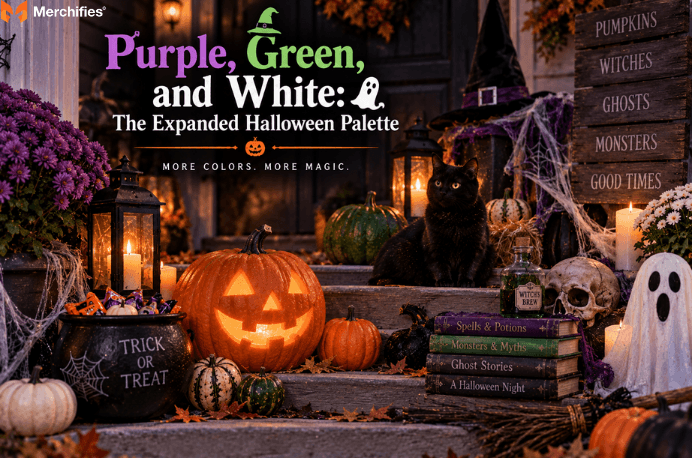
Green represents the monstrous and decayed within Halloween imagery. Frankenstein's monster, typically depicted with green-tinged skin in films since the 1930s, established green as the color of reanimated corpses and unnatural life. Zombies, swamp creatures, and various ghouls followed this convention. Green also suggests decay, mold, and the biological processes of death—appropriate themes for a holiday centered on mortality.
White symbolizes ghosts, spirits, and ethereal beings believed to cross from the spirit world during Halloween. The classic sheet ghost—a simple costume that even young children can create—relies on white's association with the immaterial and spectral. White also appears in skeleton decorations, skull imagery, and the pale faces of vampires, reinforcing connections to death and the supernatural.
For a deeper exploration of each Halloween color's meaning and how they work together in modern celebrations, see our complete guide to Halloween colors and the meaning behind orange, black, purple, and green . This expanded palette gives decorators and party planners more options while maintaining the core orange-and-black foundation that immediately communicates Halloween intent.
Orange and black trigger specific psychological responses that make them feel inherently spooky—warmth and urgency clashing against darkness and primal fear. This isn't arbitrary aesthetic preference; it reflects deep evolutionary programming and decades of cultural conditioning working together to create Halloween's distinctive emotional atmosphere.
Orange activates alertness and attention in human perception. Studies in color psychology consistently show that orange increases heart rate and creates feelings of excitement or urgency. This makes sense evolutionarily—orange often signals fire, which requires immediate attention whether it represents warmth or danger. The color sits between red's aggression and yellow's cheerfulness, creating an unstable emotional state that keeps viewers engaged.
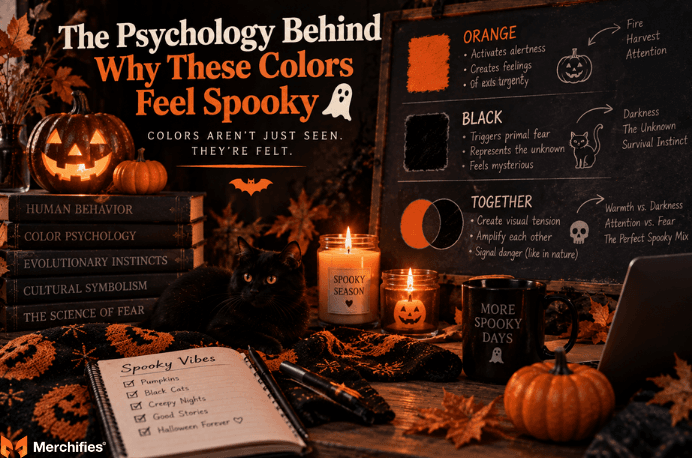
Black activates primal fear responses by representing the unknown and unseen. Human ancestors survived by avoiding darkness, where predators could lurk undetected. This survival instinct persists in modern psychology; people consistently rate dark environments as more threatening than well-lit ones, even when no actual danger exists. Black absorbs light rather than reflecting it, creating visual voids that the brain interprets as potential threats requiring vigilance.
As Cameron Foster notes, the orange-black combination mimics nature's warning colors found in dangerous creatures. Wasps, monarch butterflies, poison dart frogs, and coral snakes all display orange and black patterns that signal toxicity or defensive capability. Humans evolved to notice and avoid these color combinations, making Halloween's palette feel subtly threatening on a biological level that operates below conscious awareness.
The contrast between warm orange and cold black creates visual tension that feels inherently unsettling. Color theory describes this as simultaneous contrast—placing complementary or opposing colors together amplifies their individual impacts. Orange appears warmer and more urgent against black; black appears darker and more ominous against orange. This mutual intensification produces the distinctive atmosphere that makes Halloween decorations immediately recognizable.
Cultural conditioning reinforces these biological responses through repeated exposure. Children raised in Western cultures encounter orange-and-black Halloween imagery from their earliest years, forming permanent associations between these colors and the holiday's spooky themes. By adulthood, seeing orange and black together automatically triggers Halloween-related thoughts and feelings, regardless of context or season.
Understanding Halloween color symbolism helps party planners, decorators, and hosts create more atmospheric and emotionally resonant celebrations. The knowledge transforms decoration from random accumulation into intentional design that maximizes the holiday's distinctive mood. Whether decorating a single room or an entire property, strategic use of orange and black—supplemented by purple, green, and white—creates experiences that feel authentically Halloween.
Decorations work most effectively when they honor the traditional color balance. Orange should dominate in welcoming areas—porch lights, entryway decorations, and spaces where guests first arrive. Black intensifies as visitors move deeper into decorated spaces, creating a journey from safety into mystery. This gradient mirrors the original Samhain experience of gathering around bonfires surrounded by darkness.
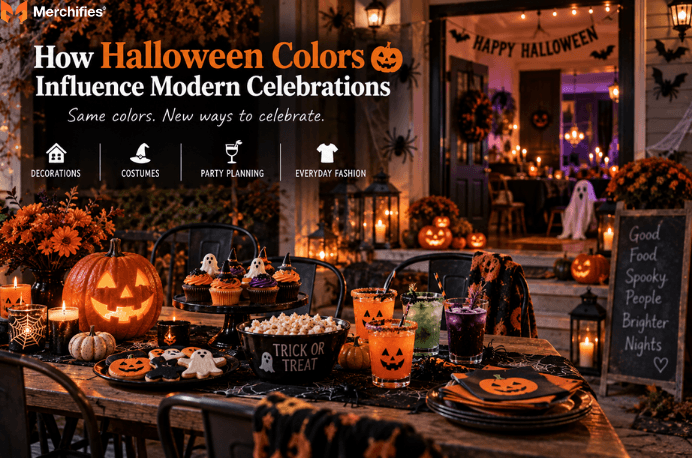
Costume choices benefit from similar awareness. Traditional Halloween costumes in orange and black read as immediately festive, while purple adds magical sophistication and green suggests monstrous transformation. Mixing multiple Halloween colors creates visually complex costumes that photograph well and communicate clear holiday participation without requiring elaborate props or accessories.
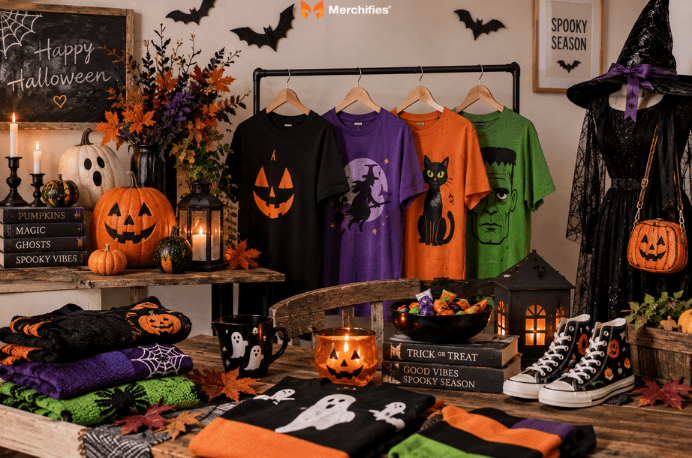
Modern Halloween fashion incorporates these colors into everyday seasonal wear—not just costumes for specific events. Merchifies carries Halloween-themed graphic tees featuring classic orange-and-black designs alongside purple and green variations. This casual approach lets people express holiday spirit throughout October without committing to full costume mode, appropriate for offices, schools, and everyday errands during the spooky season.
Party planning with color awareness creates more cohesive experiences. Food and drink presentations in Halloween colors—orange cocktails, black tablecloths, purple lighting—transform ordinary gatherings into immersive celebrations. Table settings, invitation designs, and even playlist artwork benefit from consistent color application that signals Halloween throughout every touchpoint.
The emotional impact of proper color use shouldn't be underestimated. Guests entering a space decorated with intentional Halloween colors immediately relax into celebratory mood, understanding that the environment welcomes seasonal playfulness. Poor color choices—too much black without orange relief, or clashing non-Halloween colors—create confused atmospheres that undermine celebration intent.
Halloween t-shirts and seasonal apparel bring the classic orange-and-black color palette into comfortable casual wear that works throughout October. This represents an evolution from Halloween as single-day costume event to Halloween as month-long seasonal celebration. Quality apparel in traditional Halloween colors lets people participate in the holiday's spirit without the commitment or discomfort of full costumes.
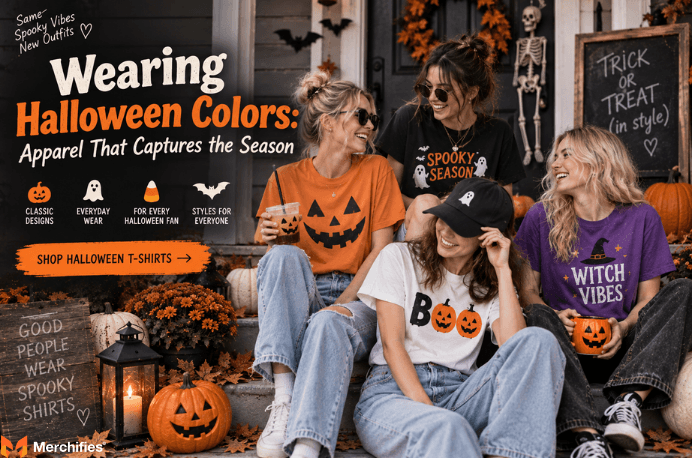
Orange and black graphic tees capture holiday energy for those who want seasonal style appropriate for everyday activities. These shirts work for grocery shopping, school pickup, workplace casual days, and weekend errands—situations where full costumes would feel excessive but plain clothing feels like missed opportunity. The colors immediately communicate Halloween appreciation to others who share seasonal enthusiasm.
Family and group matching Halloween shirts create coordination opportunities that enhance shared experiences. Parents and children in matching designs make trick-or-treating photos more memorable. Friend groups attending Halloween events together project unified festive energy. Couples in complementary Halloween apparel signal relationship playfulness. The honest trade-off: matching shirts require advance planning and size coordination, but the resulting photos and shared experience typically justify the effort.
Quality matters for Halloween apparel intended to last beyond single use. Cheaper shirts fade after washing, losing the vibrant orange and deep black that make them effective seasonal wear. Better construction and printing means shirts remain wearable across multiple October seasons, representing better long-term value despite higher initial cost.
Browse Merchifies Halloween t-shirt collections —including vintage horror designs, spooky typography, and classic monster graphics—to find styles that match your approach to the season. Whether you prefer subtle seasonal nods or bold Halloween statements, the right apparel lets you carry October's energy wherever the month takes you.
Drawing on Cameron Foster's work with seasonal celebrations, the key insight is that Halloween colors work because they connect modern celebrations to thousands of years of human tradition. Orange and black aren't arbitrary choices—they're the visual language of humanity's oldest negotiations with darkness, death, and the changing seasons. Wearing these colors, decorating with them, or simply understanding their origins connects participants to something far older and more meaningful than commercial holiday marketing. That connection gives Halloween its enduring power and explains why orange and black still feel right after all these centuries.
-d4c38c342cdf20ca.jpeg)

-b555fcc6b204c456.jpeg)