 Worldwide Shipping
 Secure Payments
 Free Return
 Local Support
-da0801079a650a2e.jpeg)
17 Year Anniversary Quotes: 110+ Funny, Romantic & Furniture Wishes (2026)
Mar, 12 2026
The history of Labor Day stretches back to 1882 when workers risked their jobs to march for basic rights. Learn how tragedy, organizing, and persistence transformed a New York parade into a federal holiday.
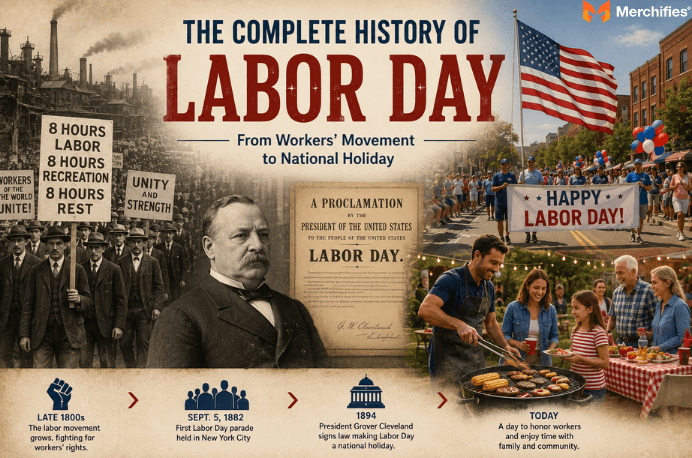
Based on Benjamin Clarke's research into American labor traditions, the history of Labor Day begins on September 5, 1882, when over 10,000 workers marched through lower Manhattan in what became the first celebration of American labor. Within 12 years, tragedy and political pressure would transform this grassroots parade into a federal holiday signed into law by President Grover Cleveland. As of 2026, Labor Day remains the only U.S. holiday dedicated specifically to honoring the contributions of working people, though how Americans observe it has changed dramatically from those first union-organized marches.
Key facts about the history of Labor Day:
First celebrated September 5, 1882 in New York City
Became federal holiday June 28, 1894
Founded by Central Labor Union organizers
Pullman Strike deaths accelerated federal recognition
Labor Day originated from the American labor movement's fight for basic worker protections during the late 1800s. The Central Labor Union in New York City organized the first celebration on September 5, 1882, as both a protest against brutal working conditions and a display of collective pride. This was not merely a day off. Workers who marched risked their livelihoods. Being identified as a union sympathizer could mean immediate termination and blacklisting across entire industries.
The first Labor Day served a dual purpose that competitors often miss when recounting labor day history. Yes, it celebrated workers. But it also demonstrated political power. When 10,000 people march together, politicians notice. The Central Labor Union understood this, which is why they chose a public parade rather than a private gathering. They wanted to be seen.
Understanding why workers organized requires looking at the conditions they faced daily. The next section explores the reality of industrial labor that made this movement not just desirable but necessary for survival.
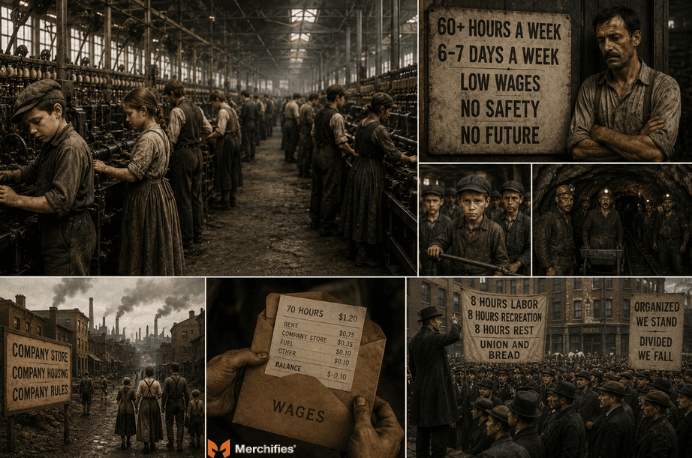
The average American industrial worker in the 1880s labored 60 or more hours across six to seven days each week. This was not exceptional. This was standard. Factories operated on the assumption that workers were expendable, and the supply of immigrant labor seemed endless.
Children as young as five worked in textile mills and coal mines. Safety regulations did not exist in any meaningful form. When a worker lost a hand to machinery or died in a mine collapse, families received nothing. No compensation. No pension. Often, they received an eviction notice from company housing.
Poverty wages kept families trapped. A worker might labor 70 hours and still not earn enough to pay rent in the company town where they were required to live. Debt accumulated. The cycle continued. Organizing meant risking everything, yet workers organized anyway because the alternative was accepting this as permanent.
Union organizers faced violence. Companies hired private security forces to break up meetings. Workers were fired, blacklisted, and sometimes beaten for attempting to improve conditions. The honest trade-off facing any worker considering union membership was stark: fight for better conditions and risk losing your job entirely, or accept exploitation and keep feeding your family. Many chose to fight.
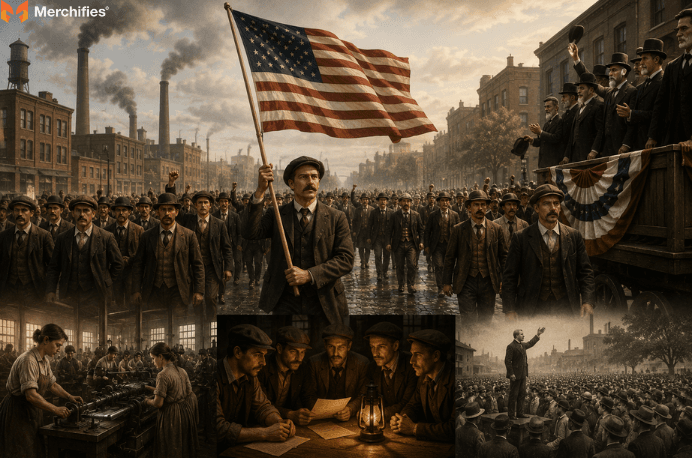
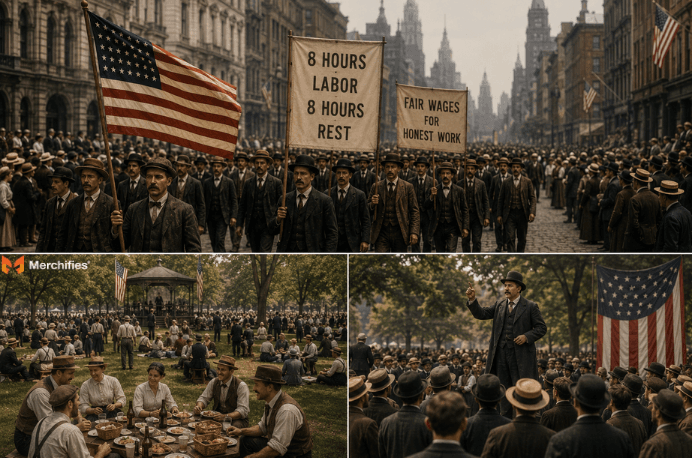
More than 10,000 workers marched through lower Manhattan on September 5, 1882, despite knowing they might be fired for participating. The parade began at City Hall and wound through the streets to Wendel's Elm Park, where speeches, food, and celebration awaited.
Workers carried signs demanding the eight-hour workday. They demanded fair wages. They demanded to be treated as human beings rather than interchangeable parts in an industrial machine. The Central Labor Union had organized this event with support from the Knights of Labor, one of the largest labor organizations of the era.
What made this first Labor Day remarkable was not just the march itself but the atmosphere afterward. At Wendel's Elm Park, workers shared picnic food, listened to speeches about their collective power, and simply enjoyed a day free from the factory floor. For many, it was their only day off that month.
This combination of protest and celebration became the model. Other cities began holding their own Labor Day events. By the mid-1880s, the holiday had spread beyond New York, though federal recognition remained over a decade away.
Two men receive credit for founding Labor Day, and historians continue debating their exact contributions. Peter McGuire, a carpenter and co-founder of the American Federation of Labor, proposed the holiday to the Central Labor Union. Matthew Maguire, a machinist serving as secretary of the Central Labor Union, may have organized the actual first celebration.
The evidence supports both claims. McGuire certainly advocated publicly for a labor holiday and had the political connections to push the idea forward. Maguire had the organizational role within the CLU that would have placed him at the center of event planning. Their names differ by only one letter, which has added to the historical confusion.
The Department of Labor itself acknowledges this ambiguity without definitively settling it. Why does this matter to modern readers? Because the debate reflects something true about Labor Day: it belongs to workers collectively, not to any single founder. The holiday emerged from a movement, not from one man's vision. Whether McGuire proposed it or Maguire organized it, thousands of workers chose to march. That collective action created Labor Day.
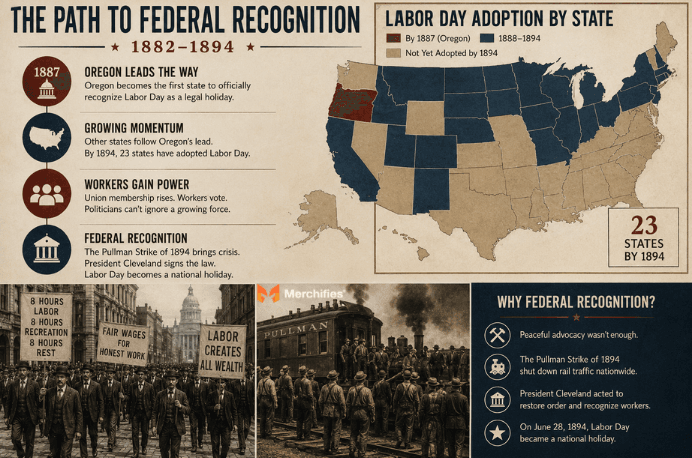
Oregon became the first state to officially recognize Labor Day as a legal holiday in 1887, five years after the first celebration. Other states followed. By the time federal legislation passed in 1894, 23 states had already adopted the holiday.
This state-by-state adoption demonstrated growing worker political influence. Union membership was increasing. Workers were voting. Politicians who wanted to remain in office could not ignore a constituency that now celebrated its own holiday across nearly half the nation.
The labor movement history of this period shows a steady accumulation of power. Each state that recognized Labor Day validated the movement's legitimacy. Each parade demonstrated numbers. Each organized workplace proved that collective bargaining could succeed.
Yet federal recognition required something more. It came through tragedy, not through gradual progress. The Pullman Strike of 1894 forced President Cleveland's hand in a way that peaceful advocacy had not.
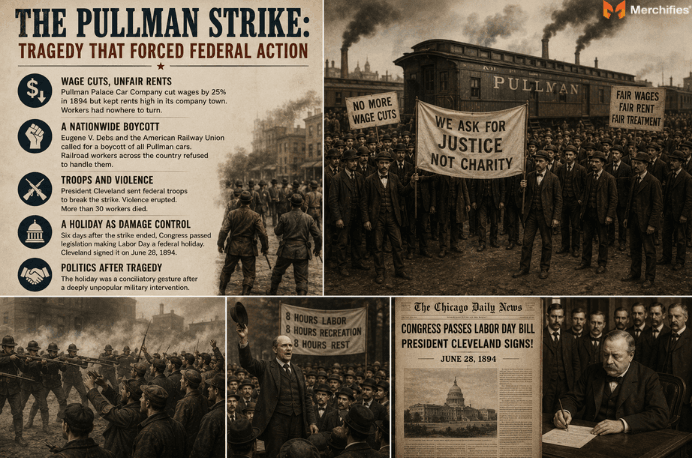
The Pullman Palace Car Company cut wages by 25 percent in 1894 without reducing rent in its company town, sparking a strike that would change American labor law. Workers who built Pullman's luxury railroad cars lived in Pullman, Illinois, where the company owned every building. When wages dropped but rent stayed the same, workers had nowhere to turn.
As Benjamin Clarke notes, the strike escalated rapidly when the American Railway Union, led by Eugene V. Debs, announced a boycott of all Pullman cars. Railroad workers across the country refused to handle any train carrying Pullman equipment. Commerce ground toward a halt.
President Cleveland sent federal troops to break the strike. Violence erupted. More than 30 workers died. The strike collapsed, but public sympathy largely sided with the workers. The Cleveland administration faced criticism for sending soldiers against American citizens fighting for fair wages.
Six days after the strike ended, Congress passed legislation making Labor Day a federal holiday. President Cleveland signed it on June 28, 1894. The timing was not coincidental. The holiday served as a conciliatory gesture to organized labor after a deeply unpopular military intervention. What workers could not win through the strike itself, they gained through the political aftermath.
American labor leaders deliberately chose September to distance their holiday from International Workers' Day on May 1. The May date commemorates the 1886 Haymarket affair in Chicago, where a bomb killed police officers during a labor rally and subsequent violence resulted in worker deaths. The event became associated with anarchism and radical politics.
American union leaders wanted a holiday that celebrated workers without the political baggage. September offered a clean date with no existing associations. The first labor day celebration had already established September as the tradition in the United States, making it easier to continue rather than switch.
The choice was also strategic. A September holiday avoided conflicts with existing May celebrations and allowed Labor Day to mark the unofficial end of summer. This positioning made the holiday more appealing to politicians who might hesitate to support anything resembling radical labor movements.
Today, most countries observe May 1 as their labor holiday. The United States remains distinct with its September date. This is not an accident of history but a deliberate choice made by American labor leaders navigating the political landscape of the 1880s.
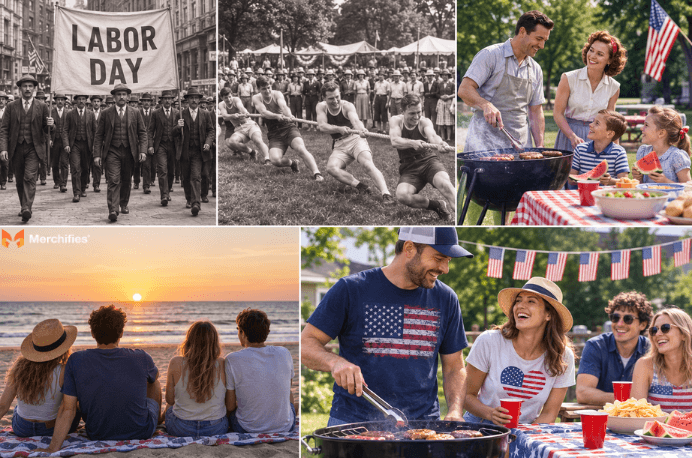
Early Labor Day celebrations centered on parades, speeches, and demonstrations of union solidarity, but the holiday has transformed into something quite different. Those first marches through Manhattan were political statements. Workers wore their best clothes, carried their union banners, and listened to speeches about the eight-hour day.
By the early twentieth century, community elements expanded. Athletic competitions, picnics, and family gatherings supplemented the political programming. Labor Day became a celebration of community as much as a statement of worker power.
The post-World War II era accelerated this shift. As union membership peaked and worker protections became law, the urgency that drove those first parades faded. Labor Day evolved into the unofficial end of summer, marked by family barbecues, final beach trips, and retail sales.
Modern observance blends relaxation with recognition. Some Americans attend parades that maintain the labor movement tradition. Others spend the day with family, perhaps wearing red, white, and blue or apparel that honors worker heritage. Merchifies carries Labor Day-themed shirts in various styles that let people express connection to this history while celebrating with friends and family.
Neither approach is wrong. The workers who marched in 1882 wanted better lives, which includes time for rest and celebration. A Labor Day barbecue honors that goal even if it looks different from a union parade.
The labor movement that created Labor Day also created the working conditions most Americans take for granted today. The eight-hour workday. Minimum wage laws. Workplace safety regulations. Workers' compensation for injuries. The right to organize without being fired. None of these existed before workers demanded them.
Child labor laws ended the practice of sending five-year-olds into factories. Weekends became standard. Paid vacation became common. Each of these protections required organizing, striking, and sometimes dying for causes that employers insisted would destroy the economy.
Modern labor issues continue this history. Gig economy workers debate whether they deserve employee protections. Wage gaps between executives and workers reach historic highs. Union membership has declined from its mid-century peak. The questions workers asked in 1882 remain relevant: What do workers deserve? How much power should employers have? When is organizing justified?
Drawing on Benjamin Clarke's work with American holiday traditions, the history of Labor Day offers perspective on these ongoing debates. The workers who marched did not know they would succeed. They organized anyway. They faced consequences. Some lost jobs. Some faced violence. And over decades, conditions improved because they refused to accept the alternative.
Whether you honor Labor Day with a family gathering, attend a union event, or simply enjoy the day off, the holiday connects to real sacrifices that built protections workers still rely on. Browse Merchifies Labor Day collection , including commemorative shirts and patriotic apparel, to find styles that match how you celebrate this American tradition. Understanding the full meaning of Labor Day makes the holiday more than just a long weekend.
-d4c38c342cdf20ca.jpeg)

-b555fcc6b204c456.jpeg)