 Worldwide Shipping
 Secure Payments
 Free Return
 Local Support
-da0801079a650a2e.jpeg)
17 Year Anniversary Quotes: 110+ Funny, Romantic & Furniture Wishes (2026)
Mar, 12 2026
Learn how a generous 4th-century bishop became the jolly red-suited figure who visits homes every Christmas Eve. This complete history traces Santa's journey from ancient Turkey to your living room.
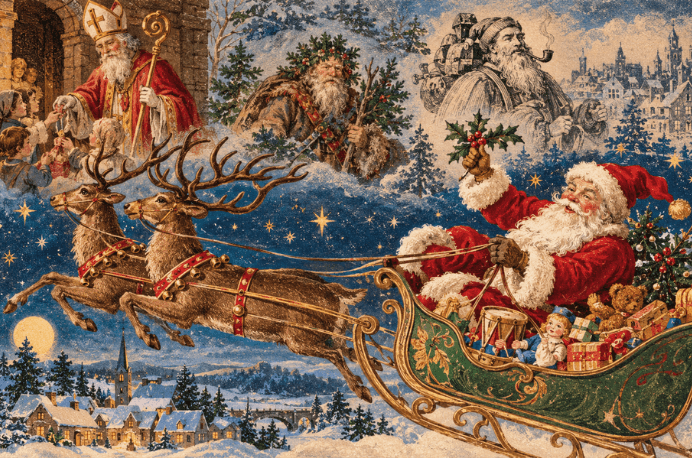
According to Olivia Bennett's research into Christmas traditions, the santa claus origin story begins not at the North Pole but in a sun-drenched Mediterranean town over 1,700 years ago. The figure we call Santa Claus evolved from Saint Nicholas, a 4th-century Christian bishop from Myra in modern-day Turkey, whose legendary generosity toward children and the poor established the template for anonymous, joyful gift-giving that persists today. As of 2026, Santa remains the most recognized secular Christmas symbol worldwide, yet few people understand how a Greek bishop became a fur-clad figure with flying reindeer. This journey spans continents, centuries, and cultures—each adding layers to the mythology until the Santa we recognize emerged in 19th-century America.
Quick Summary: Understanding Santa's Origins
Saint Nicholas was a real 4th-century bishop from Myra, Turkey
Dutch settlers brought "Sinterklaas" traditions to America
American writers and artists created the modern Santa image
Coca-Cola popularized but did not invent the red suit
Santa Claus originated from Saint Nicholas, a real 4th-century Christian bishop renowned for secret acts of generosity, particularly toward children and those in poverty. His story spread throughout Europe during the medieval period, morphing as it traveled through different cultures and merged with local folklore traditions. The name "Santa Claus" itself traces directly to Dutch settlers in 17th-century New Amsterdam—now New York City—who brought their celebration of "Sinterklaas" (a shortened form of Sint Nikolaas) to American shores.

The modern Santa Claus represents a remarkable cultural fusion. He combines the historical bishop's generous spirit with European folklore figures like Father Christmas, Germanic winter traditions, and distinctly American literary and artistic contributions. By the mid-1800s, American writers had transformed this Old World saint into something entirely new: a jolly, pipe-smoking visitor who traveled by reindeer-drawn sleigh on Christmas Eve rather than December 6th.
Understanding the santa claus origin means recognizing that no single culture created him. Instead, he emerged gradually through centuries of storytelling, artistic interpretation, and cultural exchange. The red suit, the reindeer, the North Pole workshop, the chimney entrance—each element has a traceable history, and none appeared fully formed. What we celebrate today represents the accumulated traditions of countless communities, all building upon that original foundation of generosity established by a Mediterranean bishop nearly two millennia ago.
Nicholas was born around 270 AD in Patara, a prosperous port city in the Roman province of Lycia, located in what is now southern Turkey. He rose to become the Bishop of Myra, a nearby city, where he gained a reputation for piety, compassion, and remarkable generosity that would echo through centuries. The historical Nicholas lived during a pivotal era for Christianity—he reportedly attended the Council of Nicaea in 325 AD, though documentation from this period remains incomplete.
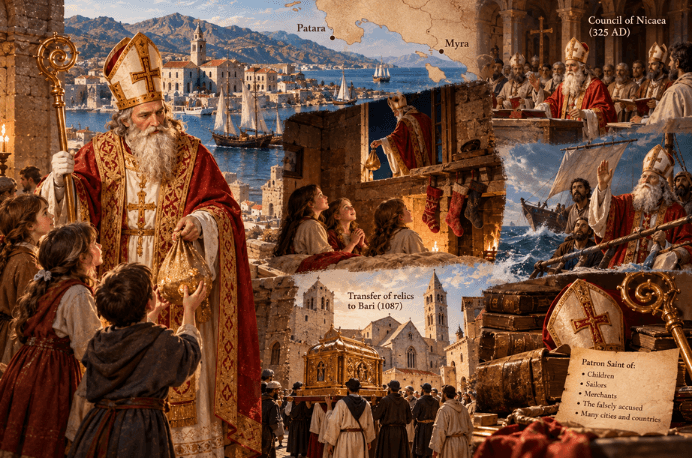
The most famous legend surrounding Nicholas involves three sisters facing destitution. Their father, unable to afford dowries, faced the horrifying prospect of selling his daughters into servitude or worse. According to tradition, Nicholas secretly threw bags of gold coins through their window on three consecutive nights, providing each daughter with a dowry and saving the family from ruin. This tale of anonymous, life-changing generosity became the prototype for Santa's secret gift-giving. Some versions specify that Nicholas threw the gold down the chimney, where it landed in stockings hung to dry by the fire—possibly explaining our modern stocking tradition.
Nicholas became patron saint of children, sailors, merchants, the falsely accused, and numerous cities and countries. His feast day, December 6th, established a medieval European tradition of gift-giving in his honor. Children would leave shoes or stockings out the night before, hoping to find them filled with treats by morning. In many European countries, this tradition continues distinctly from Christmas celebrations.
When Nicholas died on December 6th, 343 AD, his reputation for miracles and generosity had already spread widely. In 1087, Italian merchants transported his relics from Myra to Bari, Italy, spreading his cult throughout Western Europe. This relocation proved crucial—as Bari became a pilgrimage destination, Nicholas's fame reached regions that would later shape the Santa Claus we recognize. Churches dedicated to him appeared from Russia to the British Isles, each culture absorbing his legend and adding local characteristics.
European folklore contributed essential elements to Santa's appearance, behavior, and mythology long before he crossed the Atlantic Ocean. Different regions developed their own interpretations of the gift-bringer figure, and these variations eventually merged in the American cultural melting pot. Understanding these European roots reveals why Santa contains such diverse, sometimes contradictory characteristics.
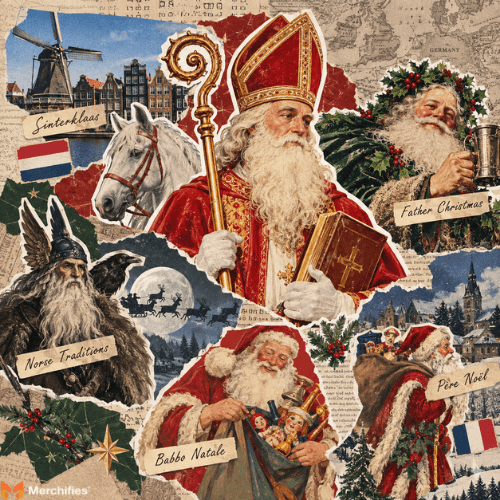
The Dutch Sinterklaas tradition presents perhaps the most direct ancestor of American Santa. Dutch and Belgian children anticipate Sinterklaas's arrival on December 5th eve, when this tall, dignified bishop figure rides a white horse across rooftops. He wears traditional bishop's robes—including red vestments—and carries a staff. Helpers assist him in determining which children behaved well throughout the year. Dutch families leave carrots and hay in shoes for Sinterklaas's horse, receiving small gifts and chocolate letters in return. This tradition remains vibrant today, celebrated separately from Christmas Day festivities.
British Father Christmas evolved quite differently. Originally, this figure personified Christmas feasting, merriment, and adult celebration rather than children's gift-giving. Dressed in green robes and crowned with holly, Father Christmas represented the spirit of good cheer during the holiday season. He appeared in medieval mummers' plays and later in Charles Dickens's "A Christmas Carol" as the Ghost of Christmas Present. Only in the late 19th century did Father Christmas merge with American Santa imagery, adopting gift-bringing duties he originally lacked.
Germanic and Norse traditions contributed additional mythological elements. Some scholars trace connections to Odin, the Norse god who sported a long white beard and rode an eight-legged flying horse named Sleipnir during the midwinter Wild Hunt. Odin was said to observe people's behavior and reward the worthy. While direct influence remains debated among historians, the parallels are striking—an elderly, bearded figure flying through winter skies, judging behavior, and distributing rewards.
French Père Noël, Italian Babbo Natale, German Weihnachtsmann, and Spanish Papá Noel each developed regional characteristics while sharing common themes. Some brought helpers, others had specific foods left for them, and delivery methods varied from chimneys to windows to shoes left by doors. When European immigrants crossed the Atlantic, they carried these diverse traditions—and in America, they would blend into something unprecedented.
The United States fundamentally reinvented Santa Claus, transforming a European collection of traditions into the unified, iconic figure recognized worldwide today. This American transformation occurred primarily during the 19th century through the contributions of specific writers, poets, and illustrators whose creative works defined Santa's appearance, personality, and mythology. Dutch settlers in New Amsterdam—later renamed New York—provided the foundation, but American innovation built the structure.
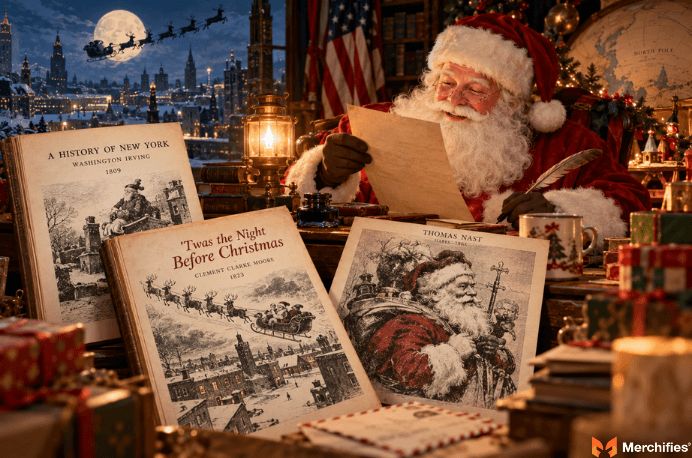
Washington Irving's satirical 1809 book "A History of New York" first portrayed Saint Nicholas as a characteristically American figure. Irving described a jolly St. Nicholas flying over rooftops in a wagon, smoking a pipe, and bringing gifts—departing significantly from the solemn bishop of European tradition. While Irving wrote satirically, his vision captured popular imagination and established precedents that later writers would develop.
The most influential single contribution came from Clement Clarke Moore's 1823 poem "A Visit from St. Nicholas," now universally known as "'Twas the Night Before Christmas." Moore's poem established canonical Santa traits that remain standard two centuries later. His Santa drove a miniature sleigh pulled by eight reindeer, each named individually: Dasher, Dancer, Prancer, Vixen, Comet, Cupid, Donner, and Blitzen. Santa entered homes through chimneys, had a round belly that shook "like a bowl full of jelly," twinkling eyes, rosy cheeks, and a white beard. Moore moved Santa's visit from December 5th (St. Nicholas Eve) to Christmas Eve, permanently linking the figure to December 25th in American consciousness.
Thomas Nast, a German-American illustrator working for Harper's Weekly, translated these literary descriptions into visual form through his illustrations published between 1863 and 1886. As Olivia Bennett notes, Nast's artwork established visual conventions including Santa's North Pole workshop filled with industrious elves, the book where Santa records children's behavior, and the portly figure dressed in fur-trimmed clothing. Nast's Santa evolved over decades, gradually becoming larger, more grandfatherly, and more elaborately dressed. His illustrations, published during and after the Civil War, helped establish a unified national Santa image during a period when Americans sought shared cultural touchstones.
These distinctly American contributions traveled back across the Atlantic, influencing and sometimes replacing traditional European gift-bringer figures. The American Santa became globalized through commerce, media, and cultural exchange, eventually dominating Christmas imagery worldwide. Today, the red-suited, chimney-descending, reindeer-driving Santa originated not in ancient Europe but in 19th-century New York.
One of the most persistent Christmas myths holds that Coca-Cola created the red-suited Santa Claus through their 1930s advertising campaigns—but historical evidence clearly refutes this claim. The red-suited, jolly Santa appeared consistently in illustrations, advertisements, and Christmas cards for decades before Coca-Cola ever featured him. Understanding what Coca-Cola actually contributed requires examining the visual record predating their famous campaigns.

Louis Prang, a German-American lithographer, popularized Christmas cards in America during the 1870s and 1880s. His cards frequently depicted Santa in red clothing, establishing this color association in mainstream American culture. Thomas Nast's Harper's Weekly illustrations, spanning 1863-1886, showed Santa in various outfits but often favored reddish hues. Early 20th-century advertisements for various products—including White Rock beverages, which featured red-clad Santa years before Coca-Cola—demonstrate that the red suit had become standard before the soda company entered the picture.
What Coca-Cola genuinely contributed was standardization and global reach. Artist Haddon Sundblom created Santa illustrations for Coca-Cola advertisements from 1931 through 1964. His paintings depicted a warm, grandfatherly, distinctly human Santa—less elf-like than earlier renditions. Sundblom's Santa had realistic proportions, a genuinely friendly expression, and appeared in intimate domestic settings that suggested personal connection. These advertisements appeared in magazines with massive circulation, on billboards, in store displays, and eventually on television. Coca-Cola's marketing budget ensured that Sundblom's specific Santa reached more eyes than any previous depiction.
The honest trade-off in this misconception: if you want to credit Coca-Cola, acknowledge they popularized and globalized a consistent Santa image rather than invented fundamental characteristics. The red suit, white beard, and jolly demeanor predated their involvement. However, when people worldwide picture Santa today, they're often visualizing elements Sundblom refined and Coca-Cola distributed. The company did not create Santa, but they significantly influenced which version became dominant. Coca-Cola itself has acknowledged this distinction, noting they helped standardize rather than originate Santa's appearance.
Contemporary Santa Claus traditions vary dramatically across cultures while maintaining the core theme of generous, joyful gift-giving that traces back to Saint Nicholas himself. The American Santa has influenced global celebrations, yet regional variations persist and sometimes blend with imported imagery to create unique local traditions. Exploring these differences reveals how the saint-turned-icon adapts to diverse cultural contexts.

North American tradition centers on Christmas Eve anticipation. Children leave cookies and milk for Santa (sometimes adding carrots for reindeer), then wake Christmas morning to find gifts beneath decorated trees. Santa enters through chimneys—a detail dating to Clement Clarke Moore's poem—despite most modern homes lacking functioning fireplaces. The tradition includes elaborate "Santa tracking" by NORAD, letters addressed to the North Pole, and department store visits where children share wish lists directly. This highly commercialized version has spread globally through American media and commerce.
Many European countries maintain distinct St. Nicholas Day celebrations on December 6th, separate from Christmas gift-giving. Dutch and Belgian children receive presents from Sinterklaas in early December, then celebrate Christmas Day as a family religious holiday without a second gift-bringer figure. German families may celebrate both Nikolaustag (St. Nicholas Day) and Weihnachten (Christmas), with different gift-giving traditions for each. Austrian and Alpine regions include the frightening Krampus figure who accompanies St. Nicholas to punish misbehaving children—a tradition gaining attention in American popular culture.
Southern Hemisphere countries face the practical challenge of Christmas occurring during summer. Australian Santa often appears in beach settings, sometimes wearing shorts and arriving by surfboard or boat rather than sleigh. Despite temperatures making fur-trimmed suits absurd, the traditional red outfit often prevails—demonstrating how strongly American imagery dominates even where it makes no climatic sense. Australian families may celebrate with barbecues and beach outings rather than snow and hot cocoa, adapting Christmas festivities to local conditions while maintaining Santa as central figure.
Different cultures use different names while sharing recognizable characteristics. Father Christmas dominates British usage, though he has merged almost completely with American Santa. French Père Noël, Spanish Papá Noel, Italian Babbo Natale, and Russian Ded Moroz (Grandfather Frost) all serve gift-bringing functions with varying folklore and appearance details. The Japanese have adopted Christmas celebrations as a secular winter holiday, complete with Santa imagery, despite minimal Christian population—demonstrating how commercial and cultural forces spread traditions independent of religious context.
Saint Nicholas's practice of secret, thoughtful generosity established a template that continues shaping how we exchange gifts during the holiday season. The tradition of giving without expectation of recognition or reward—exemplified by Nicholas secretly throwing gold to save the three sisters—remains the philosophical foundation beneath Christmas gift-giving customs. Modern variations honor this spirit while adapting to contemporary contexts.

The Secret Santa tradition directly reflects Nicholas's approach: anonymous gift exchanges where participants focus on selecting thoughtful presents without receiving personal credit. This tradition appears in workplaces, friend groups, and families worldwide, with participants drawing names and purchasing gifts within set budgets. The history of Secret Santa traces directly to the saint's legendary anonymity. Participants experience the joy of giving while maintaining the mystery Nicholas himself practiced.
Christmas gift-giving became a widespread family practice through Santa mythology—children leaving wish lists continues Nicholas's legacy of generous attention to young people's desires. Parents worldwide participate in elaborate performances, maintaining Santa's existence as shared cultural fiction that enables wonder and magic. This conspiracy of generosity—millions of adults maintaining the story while secretly purchasing and hiding gifts—represents perhaps the largest ongoing collaborative fiction in human history.
Modern adaptations continue these traditions while emphasizing personalization and thoughtfulness. Rather than generic presents, many gift-givers seek items reflecting deep understanding of recipients. Secret Santa ideas increasingly focus on customization and personal relevance over price or flashiness. When someone receives a gift that perfectly captures their interests, they experience what Nicholas's beneficiaries must have felt—being truly seen and valued by someone willing to act on that understanding.
Merchifies carries custom holiday apparel and personalized Christmas gifts that capture this spirit of thoughtful giving. Whether you're planning a Secret Santa exchange or choosing personalized Christmas gifts for family, you're participating in a tradition stretching back to a generous bishop in 4th-century Turkey. Drawing on Olivia Bennett's work with gift-giving traditions, the most meaningful presents reflect genuine knowledge of recipients—just as Nicholas's secret gold addressed specific needs of specific people facing specific challenges. Browse Merchifies holiday collections—including custom family apparel, personalized ornaments, and unique holiday accessories—to find items matching your recipients' personalities and interests.
-d4c38c342cdf20ca.jpeg)


-b555fcc6b204c456.jpeg)