 Worldwide Shipping
 Secure Payments
 Free Return
 Local Support
-da0801079a650a2e.jpeg)
17 Year Anniversary Quotes: 110+ Funny, Romantic & Furniture Wishes (2026)
Mar, 12 2026
Your living room is often the centerpiece of your home—a space where comfort meets style and where guests form their first impressions. Thoughtful decor choices can transform an ordinary room into a stunning, personality-filled space that reflects your taste and lifestyle. In this guide to living room decor ideas that make a statement, you'll discover creative design inspiration, bold focal points, stylish furniture arrangements, and eye-catching decorative accents. Whether your style is modern, minimalist, cozy, or eclectic, these ideas will help you create a living room that feels both inviting and unforgettable.
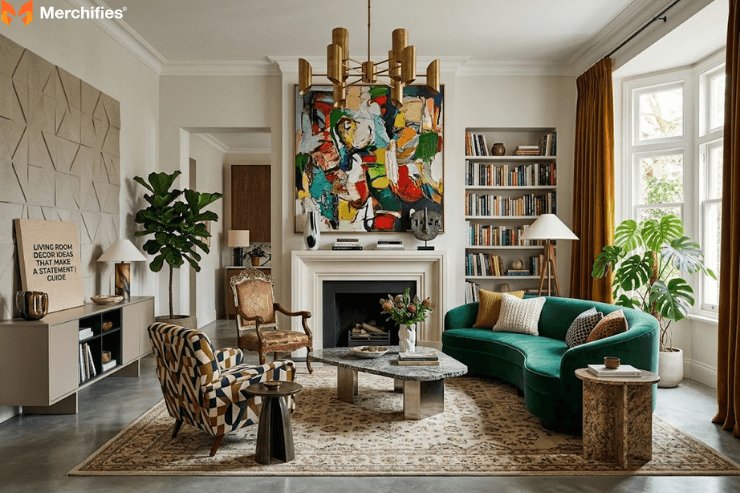
Living room decor ideas that truly make a statement share three qualities: intentional scale, purposeful contrast, and a single focal point that anchors the entire room. Most inspiration galleries dump dozens of pretty images without explaining why certain pieces command attention while others fade into background noise. The difference between a room that feels collected and one that feels cluttered comes down to understanding these principles before you shop.
As of 2026, the shift toward personalized statement pieces over mass-produced decor continues to gain momentum. Homeowners want rooms that reflect personality, not catalog pages. This guide breaks down exactly how to achieve that impact across every major decor category—with budget guidance and room-size fit advice you won't find in typical image galleries.
What makes living room decor statement-worthy:
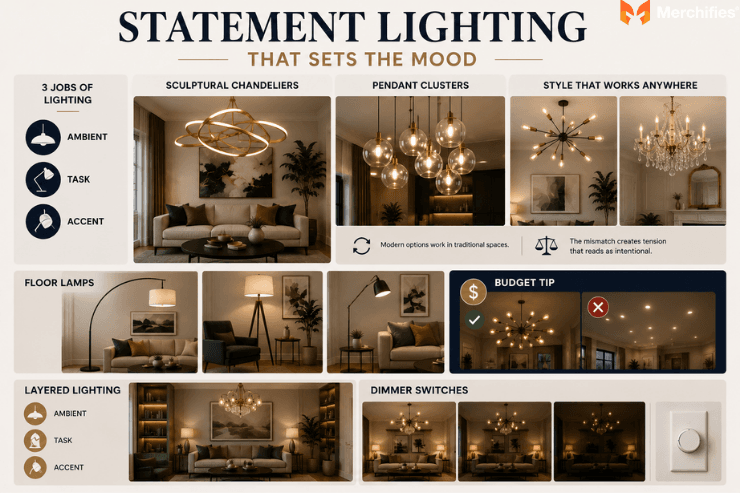
Statement decor is any piece that anchors a room's personality and draws the eye before anything else registers. Three criteria separate genuine statement pieces from expensive clutter: scale, contrast, and intentionality.
Scale means the piece commands appropriate visual weight for the space. A 12-inch vase on a massive mantel disappears. An oversized floor mirror in that same spot becomes an anchor. Contrast creates tension against surrounding elements—a bold emerald sofa against neutral walls, or a geometric rug beneath organic-shaped furniture. Intentionality means you chose the piece deliberately as a focal point, not because it was on sale.
The one-focal-point rule matters more than most realize. When everything competes for attention, nothing wins. Walk into any well-designed room and notice: your eye lands somewhere specific first. That's the statement piece doing its job.
Consider a neutral living room with beige walls, a gray sofa, and basic lighting. Adding one oversized abstract canvas in deep navy and gold transforms the entire space. The art becomes the anchor. Everything else supports it. That's statement decor working correctly. For broader context on creating cohesive spaces, this complete home decor guide covers foundational principles that apply across every room.
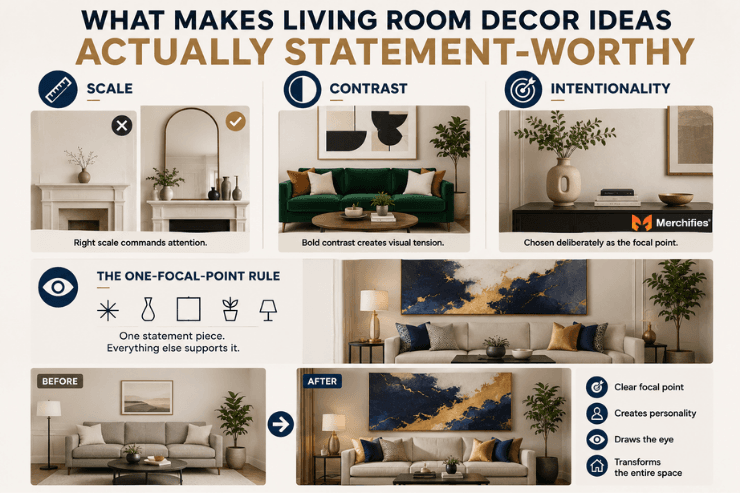
Wall treatments deliver the highest visual impact per square foot of any living room decor investment. You have three primary approaches: accent walls, gallery arrangements, and oversized art.
Accent walls work best when they highlight architectural features or define functional zones. Paint is the budget-friendly option—deep jewel tones or dramatic blacks create instant drama. Wallpaper offers pattern and texture impossible to achieve with paint alone. Textured panels (wood slats, 3D tiles, fabric) add dimension that photographs poorly but feels stunning in person.
Gallery walls divide into two camps: curated (matching frames, cohesive color palette, intentional spacing) and eclectic (mixed frames, varied sizes, collected-over-time aesthetic). Curated reads polished. Eclectic reads personal. Neither is wrong—but mixing approaches reads confused.
Oversized art as a single focal point eliminates arrangement anxiety entirely. One piece. Done. Custom prints let you create truly one-of-a-kind statement pieces that no neighbor or Instagram account will replicate—a significant advantage over mass-market options.
The honest trade-off: bold walls demand neutral furniture. If your sofa already makes a statement, keep walls understated. You cannot have competing focal points without visual chaos. For custom wall art options that create genuine one-of-a-kind impact, explore these custom wall art ideas for inspiration.
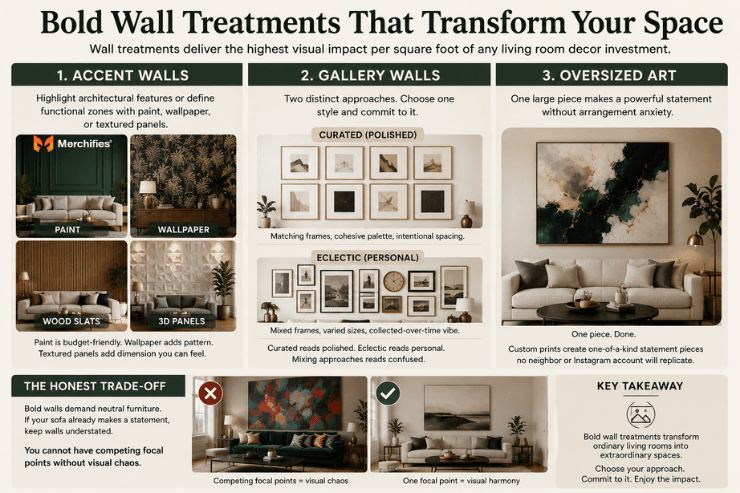
Lighting upgrades typically deliver the highest visual impact per dollar spent in any living room. The fixture you choose matters less than understanding lighting's three jobs: ambient (overall illumination), task (reading, working), and accent (highlighting features).
Sculptural chandeliers serve as functional art. They light the room while commanding attention. Pendant clusters—multiple smaller fixtures at varied heights—create visual interest without the commitment of one massive piece. Modern options work in traditional spaces. Traditional fixtures work in modern spaces. The mismatch creates tension that reads as intentional.
Floor lamps deserve more credit as statement pieces. An arc lamp over a reading corner. A sculptural tripod beside the sofa. These pieces occupy vertical space that most homeowners ignore, creating impact without competing with wall or furniture focal points.
Budget tip: one statement fixture beats five generic lights. Spend your lighting budget on one piece that makes you pause when you enter the room. Fill remaining needs with inexpensive basics that disappear visually.
Layered lighting combines all three types—ambient overhead, task lamps where needed, accent lights on art or architectural features. Dimmer switches let you shift mood without changing fixtures.
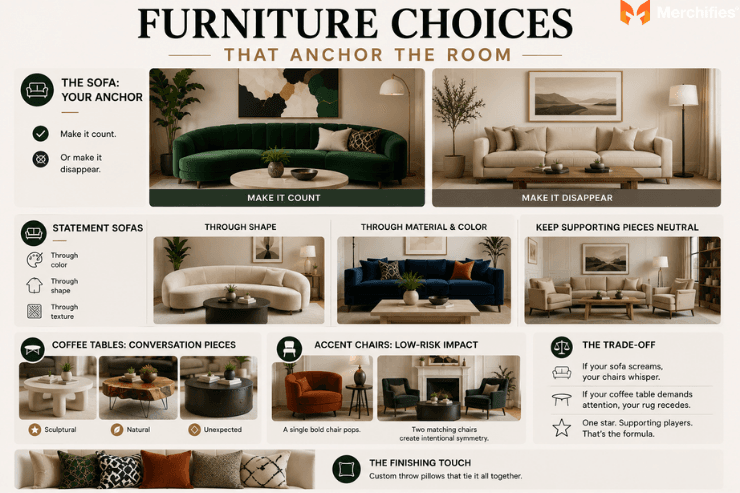
Statement furniture requires neutral supporting pieces to avoid visual competition that exhausts the eye. Your sofa occupies more visual real estate than any other piece in most living rooms. Make it count—or deliberately make it disappear.
Statement sofas differentiate through color, shape, or texture. A curved silhouette in neutral fabric makes a statement through form. A boxy modern shape in bold velvet makes a statement through material and color. Pick one approach. Combining unusual shape with unusual color often overwhelms.
Coffee tables function as conversation pieces when chosen intentionally. Sculptural bases, unexpected materials (concrete, live-edge wood, vintage industrial), or distinctive shapes draw the eye without dominating sightlines the way sofas do. This makes them safer statement bets for commitment-averse decorators.
Accent chairs offer low-risk statement opportunities. A single bold chair in an otherwise neutral seating arrangement pops without overwhelming. Two matching statement chairs flanking a fireplace create symmetry that reads intentional rather than chaotic.
The trade-off applies here too: if your sofa screams, your chairs whisper. If your coffee table demands attention, your rug recedes. Successful statement rooms choose one furniture star and cast supporting players accordingly. Merchifies carries custom throw pillows in patterns and colors that complement both bold and neutral furniture anchors.
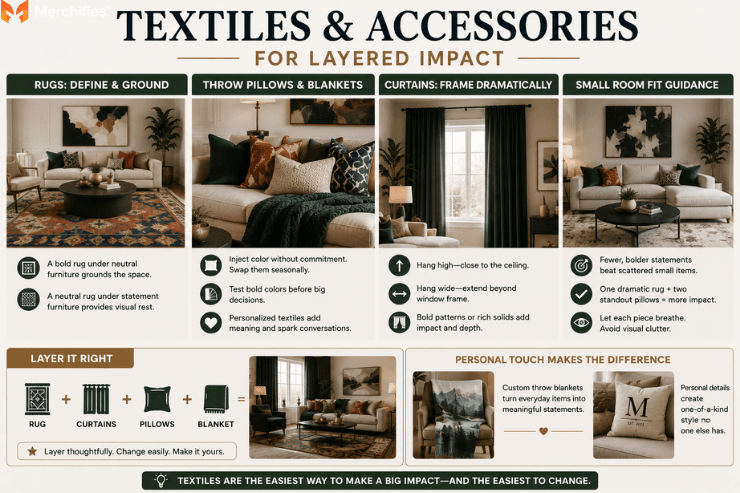
Textiles add statement-making potential that's easily changed seasonally or as tastes evolve. Rugs define seating areas and provide the largest textile surface in most living rooms. A bold rug under neutral furniture grounds the space. A neutral rug under statement furniture provides visual rest.
Throw pillows and custom blankets inject color without commitment. Swap them seasonally. Use them to test bold colors before painting walls or buying furniture. Personalized textiles add uniqueness that mass-market options can't match—a custom throw blanket with personal meaning becomes a conversation piece rather than just another accessory.
Curtains present an underused statement opportunity. Floor-to-ceiling panels in bold patterns frame windows dramatically. Solid curtains in unexpected colors (deep rust, forest green, navy) add richness without pattern overwhelm. The key: hang curtains high and wide for maximum visual impact.
Fit guidance for smaller rooms: fewer, bolder textile statements beat scattered small items. One dramatic rug plus two standout pillows creates more impact than a dozen small accessories competing for attention. For personalized throw options that make genuine statements, browse these custom throw blanket designs.
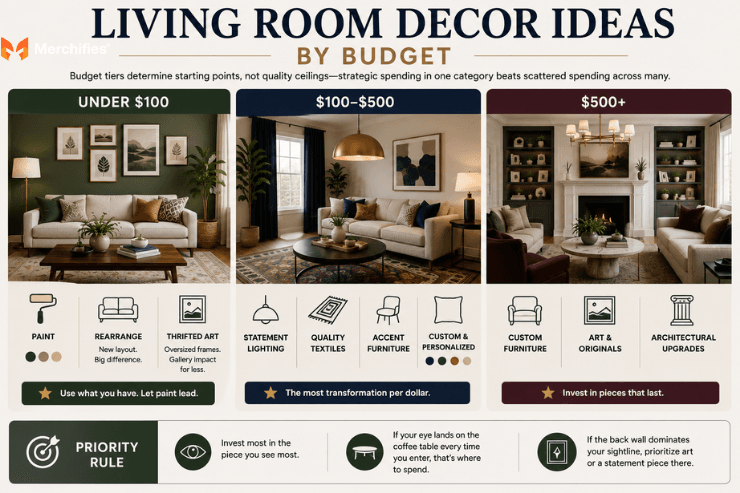
Budget tiers determine starting points, not quality ceilings—strategic spending in one category beats scattered spending across many.
Priority rule: invest most in the piece you see most. If your eye lands on the coffee table every time you enter, that's where to spend. If the back wall dominates your sightline, prioritize art or a statement piece there.
Multiple focal points competing for attention create visual noise that exhausts rather than impresses. This is the most common mistake, and the hardest to self-diagnose because each piece feels right individually.
Scale mismatch causes the second-most problems. Oversized furniture in small rooms feels oppressive. Undersized art on large walls looks like afterthoughts. Measure twice. Visual weight matters as much as physical dimensions—dark colors and heavy textures read larger than light colors and delicate textures.
Ignoring existing architectural features wastes built-in statement potential. A beautiful fireplace shouldn't compete with bold art on the same wall. Interesting windows don't need heavy treatments that hide them. Work with what your room offers before adding against it.
Trend-chasing without personal style consideration creates rooms that feel dated within seasons. Statement pieces should reflect you, not Instagram. That viral curved sofa might not suit your lifestyle. That trendy shade might not suit your light. Borrow ideas freely, but filter them through your actual needs and tastes.
The test: can you explain why each statement piece earned its spot? If the answer involves "everyone has one" or "it was on sale," reconsider. Genuine statement pieces have stories or solve problems. Everything else is just stuff.
-d4c38c342cdf20ca.jpeg)


-b555fcc6b204c456.jpeg)