 Worldwide Shipping
 Secure Payments
 Free Return
 Local Support
-da0801079a650a2e.jpeg)
17 Year Anniversary Quotes: 110+ Funny, Romantic & Furniture Wishes (2026)
Mar, 12 2026
Learn how to design custom team shirts that your group will actually want to wear. Covers fabric choices, printing methods, and ordering tips for sports teams, workplaces, and special events.
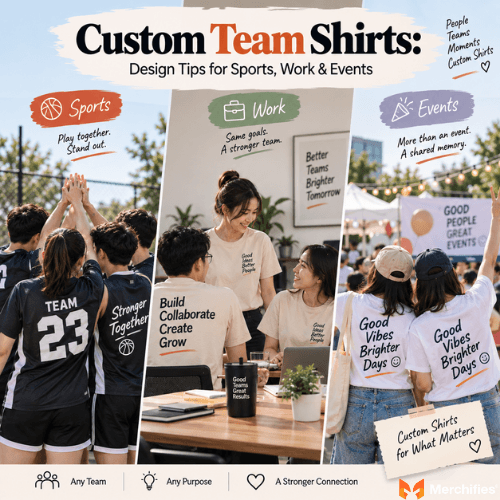
According to Lucas Bennett's research into custom apparel for group settings, the difference between custom team shirts that get worn once and shirts that become group favorites comes down to three decisions: fabric choice, design balance, and ordering logistics. Whether you're outfitting a rec league soccer team, branding your startup crew, or commemorating a family reunion, the same core principles apply—but the specific choices shift based on context. As of fall 2026, print-on-demand services have eliminated minimum order barriers, making custom team shirts accessible for groups of any size. This guide walks through design considerations by use case, fabric and printing method trade-offs, and the ordering process that prevents last-minute headaches.
Custom team shirts work when they balance visual identity with practical wearability.
Match fabric to activity level—athletic teams need moisture-wicking blends.
Keep designs simple enough to reproduce clearly at any print size.
Order 5-10% extra to cover sizing errors and late additions.
Choose printing methods based on design complexity and order volume.
Ready to order now? Merchifies offers no-minimum custom team shirts with free shipping. The guide below helps you design with confidence first—or skip ahead if you already know what you need.
Custom team shirts are apparel designed with unified branding to create group identity and visual cohesion. Unlike generic matching t-shirts pulled from a retail shelf, custom shirts carry your specific logo, colors, names, and messaging. They signal that your group is organized, committed, and part of something larger than individual members.
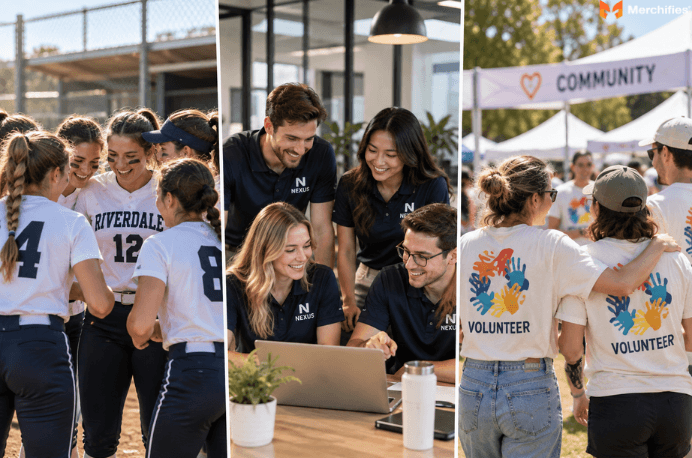
The practical value breaks into three categories. First, team cohesion—when everyone wears the same branded shirt, it creates an immediate sense of belonging. A youth basketball team walking into a tournament in matching warm-up shirts looks prepared. A corporate team at a trade show in branded polos projects professionalism. A family reunion group in custom shirts with decades of inside jokes becomes instantly identifiable in a crowded park.
Second, professional appearance matters more than most groups realize. For workplace teams, custom shirts function as soft uniforms that maintain brand consistency without the rigidity of formal dress codes. For sports teams competing in recreational leagues, matching shirts satisfy league requirements while building team identity. For charity events, custom shirts transform a loose collection of volunteers into an organized force.
Third, event memorability extends the value beyond the day itself. A well-designed custom shirt becomes a keepsake. People actually wear reunion shirts, charity walk shirts, and team championship shirts for years after the event—which means your group's moment gets remembered every time someone pulls that shirt from a drawer.
This guide covers the design decisions that make custom team shirts successful across three primary contexts: sports teams needing performance wear, workplaces needing professional branded apparel, and events needing memorable group shirts. We'll walk through fabric selection, design elements, printing methods, and ordering logistics—everything you need to make informed decisions before placing an order.
Athletic team shirts require performance fabrics that handle sweat, movement, and repeated washing without losing shape or comfort. The design requirements differ significantly from casual branded apparel because players will stress-test every seam, print, and fiber during actual competition.
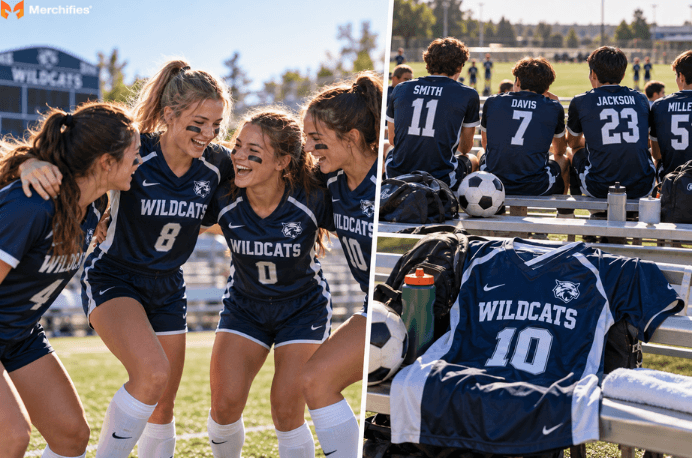
Fabric selection drives everything for sports teams. Moisture-wicking polyester blends pull sweat away from skin, keeping players cooler and more comfortable during intense activity. Pure cotton, while soft initially, absorbs moisture and becomes heavy and clingy during exertion—a poor choice for anything beyond light recreational play. Look for fabrics labeled as performance, dry-fit, or moisture-wicking. Stretch content (typically spandex or elastane) allows unrestricted movement for sports requiring range of motion like basketball, soccer, or volleyball.
Durability matters because sports shirts face repeated aggressive washing, frequent wear, and physical contact. Reinforced stitching at stress points prevents early failure. Fabric weight should match the sport—lighter weights for high-intensity cardio activities, slightly heavier weights for sports with more contact or cooler weather conditions.
Design placement requires strategic thinking for sports contexts. Numbers and names on the back need to be large enough for referees and spectators to read from distance—typically 8-10 inch numbers. Front logo placement should sit high enough on the chest to remain visible when shirts are tucked in or when players are in athletic stances. Sponsor logos, if required, need designated zones that don't interfere with uniform numbers or create visual clutter.
Color visibility becomes a safety consideration for outdoor sports. High contrast between shirt color and print color ensures readability. For teams that play outdoors in variable lighting, avoid combinations where numbers or names disappear at twilight. Indoor sports have more flexibility, but contrast still aids identification during fast-paced play.
Fit considerations for athletic wear require the goldilocks approach—not too tight to restrict movement or show every body imperfection, not too loose to catch on equipment or opponents. Athletic cuts with tapered sides and slightly longer back hems prevent untucking during movement. Offer multiple fit options if your team includes diverse body types.
Consider a rec league soccer team ordering for their fall season. They'd want moisture-wicking polyester in a mid-weight fabric, bold contrasting numbers on the back large enough to read from the sidelines, a clean logo on the front chest, and sizing that accommodates players ranging from lean to heavier builds. For a youth basketball squad, similar performance fabric requirements apply, but you might add individual names above numbers and ensure the fit works for players who haven't finished growing.
For detailed guidance on what works specifically on the back of athletic shirts, see our guide on creative ideas and design inspiration for team shirt backs .
Need just a few shirts for a small team? Print-on-demand services like Merchifies handle orders of any size without minimum requirements—practical for smaller rec leagues or teams that need to add players mid-season.
Workplace team shirts balance brand representation with comfort during work shifts, avoiding the sterile look of traditional uniforms while maintaining professional polish. The goal is apparel employees actually want to wear—not shirts that live permanently in the back of closets.
Fabric selection for workplace wear prioritizes all-day comfort over athletic performance. Breathable cotton-poly blends offer the soft hand feel of cotton with the durability and wrinkle resistance of polyester. For customer-facing roles or more formal contexts, polo shirts provide a step up in professionalism while remaining comfortable. Ring-spun cotton feels noticeably softer than standard cotton and holds up well to frequent washing.
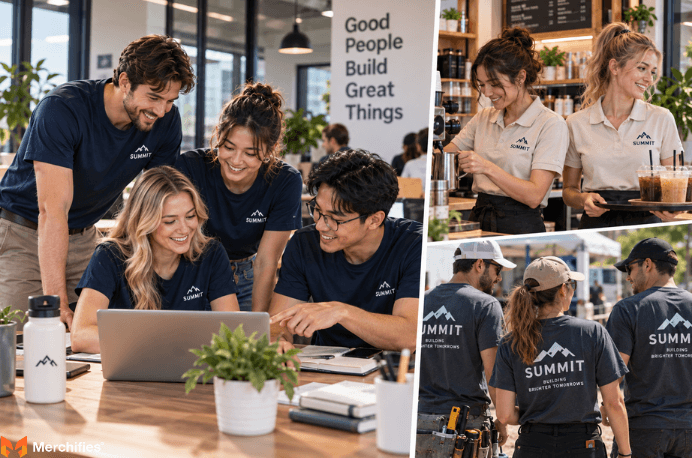
Consider the work environment when selecting weight and composition. Restaurant and food service staff benefit from stain-resistant finishes and darker colors that hide minor spills. Outdoor workers need UV protection and lighter colors that don't absorb heat. Office teams can use lighter-weight fabrics since climate control handles temperature regulation.
Logo placement on corporate apparel typically follows established brand guidelines, but the shirt medium offers some flexibility. Left chest placement is the traditional professional standard, appropriate for polos and button-down styled shirts. Center chest placement works for casual team tees and makes the logo more visible in photos. Back placement suits teams that interact with customers who might see them walking away or working in positions where backs are visible.
Sizing determines whether logos appear proportional. A logo that looks perfect on a medium shirt can look undersized on an XXL or oversized on a small. Ask your print provider about scaling logos proportionally across size ranges, or select a logo size that reads correctly across your team's size distribution.
Color coordination with existing brand assets requires attention during ordering. Match Pantone colors when precision matters—screen colors and printed colors can differ noticeably. If your brand uses specific shades, communicate those specifications to your print provider rather than relying on color descriptions.
Names and titles create personalization opportunities for workplace teams. Embroidered names last longer than printed names through repeated wash cycles and maintain a more premium appearance. Printed names cost less and work fine for shirts with lower wear frequency. Consider adding department names or job titles if that information helps customers or improves team dynamics.
The uniform versus casual branded apparel decision depends on your workplace culture and customer expectations. True uniforms require exact consistency—same shirt, same color, potentially assigned sizes. Casual branded apparel allows employees to select their own size and potentially choose from multiple approved shirt colors or styles, creating a cohesive look without military precision.
For a startup team heading to a retreat, casual matching tees in the company colors with a simple logo create team bonding without feeling corporate. For restaurant staff serving customers daily, polo shirts with embroidered names project professionalism while remaining practical for physical work. Both represent custom team shirts—just calibrated for different workplace contexts.
Testing branded apparel before committing to bulk orders makes sense for businesses exploring custom shirts for the first time. No-minimum ordering lets you sample fit, fabric feel, and print quality before scaling up to full team orders.
Event shirts prioritize memorability and emotional connection over performance or professional appearance—these are keepsakes designed to trigger fond memories years later. The design approach differs fundamentally from athletic or corporate contexts because the primary purpose is commemoration rather than function.
Design for memorability means including specific details that anchor the shirt to a particular moment: dates, locations, participant names, event themes, and inside jokes that only attendees would understand. A generic design reading "Family Reunion 2026" creates less emotional resonance than "Johnsons Hit the Lake: Cedar Point Cabin - September 2026" with a custom illustration of the actual cabin and a list of every attendee's name.
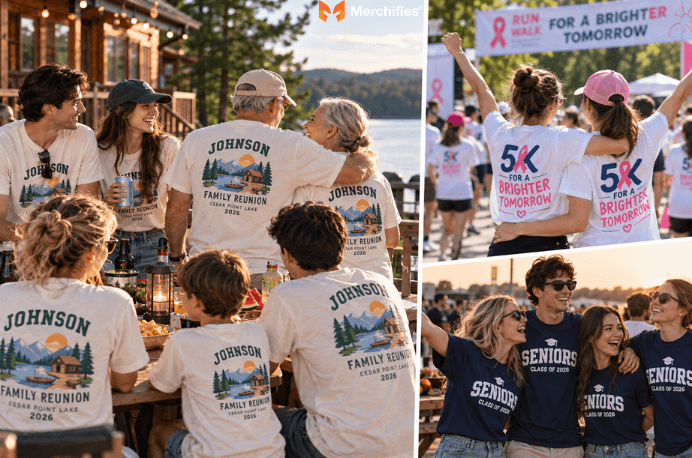
Personalization options expand significantly for event shirts since you're typically not constrained by uniform requirements or brand guidelines. Individual names, roles ("Official Grill Master," "Chief Photographer," "Designated Driver"), or fun titles for each participant create shirts that people actually want to keep. Generational designations work particularly well for family reunions—"4th Generation Johnson" connects individuals to family history.
Gift-worthy considerations matter when shirts serve as souvenirs distributed at the event. Fabric quality that feels substantial rather than cheap affects how recipients perceive the gift. Presentation matters—shirts folded neatly in individual bags with participants' names create a more memorable unboxing moment than shirts pulled from a box.
Comfort-first fabric selection makes sense for event shirts since people typically wear them during relaxed activities. Soft ring-spun cotton or cotton-poly blends feel comfortable for all-day wear at reunion picnics, charity walks, or bachelor party activities. Performance fabrics only make sense if the event involves actual physical exertion.
Sizing diversity becomes critical for events gathering mixed groups. Family reunions include everyone from young children to elderly grandparents. Charity walks draw participants across age and body type spectrums. Bachelor and bachelorette parties include friends with varying sizes. Offering a full size range and carefully collecting individual sizes beforehand prevents the awkward moment when someone's shirt doesn't fit.
Budget considerations for one-time events require different math than ongoing team apparel. You're not amortizing the design cost across years of use. That said, the per-unit cost for event shirts often matters less than group dynamics suggest—splitting a slightly higher per-shirt cost across many participants keeps individual costs minimal while dramatically improving quality.
Quick turnaround requirements frequently define event shirt orders since organizers often finalize details closer to the event date. Build in buffer time for design revisions, printing, and shipping. If the event date is fixed and approaching fast, prioritize print providers with guaranteed delivery windows or rush options.
A family reunion with generational names—"2nd Generation: The Parents," "3rd Generation: The Cousins," "4th Generation: The Little Ones"—creates a shirt that visualizes family structure while giving everyone their place. A charity 5K walk with participant names, the cause, and the date creates wearable proof of participation that people display proudly. Both require different design approaches than athletic team shirts or corporate branded apparel.
Planning a one-time event? Print-on-demand means no leftover inventory sitting in a garage. Order exactly what you need, and if someone can't make it last minute, you're not stuck with unused shirts.
The fabric and printing method you choose should match your team's activity level, design complexity, and budget—not the other way around. Making these decisions before finalizing artwork prevents expensive revisions or disappointing results.
Cotton versus polyester versus blends represents the fundamental fabric decision. Pure cotton feels soft, breathes well, and works for casual or moderate activity levels. The trade-off: cotton wrinkles more easily, shrinks if washed incorrectly, and absorbs moisture rather than wicking it away. Pure polyester resists wrinkles and moisture, making it ideal for athletic applications, but can feel less comfortable against skin and may pill over time with abrasion. Cotton-poly blends attempt to capture benefits of both—soft hand feel with improved durability and reduced shrinkage. For most non-athletic team shirts, a 50/50 or 60/40 cotton-poly blend offers the best balance.
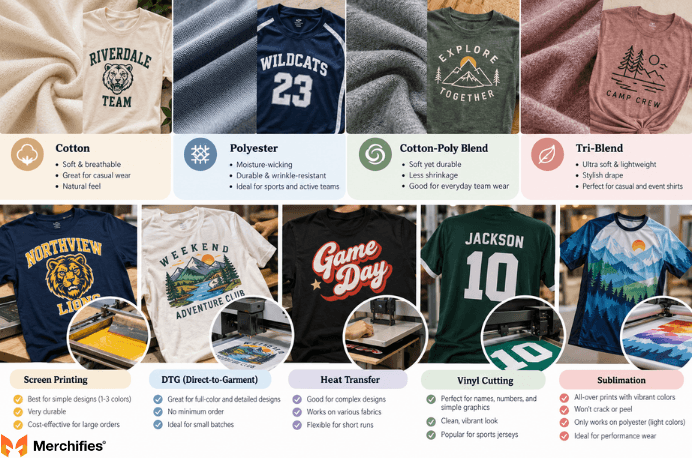
Tri-blends add rayon to the cotton-poly mix, creating an exceptionally soft fabric with excellent drape. These work well for fashion-forward casual shirts where comfort and appearance matter more than durability. They tend to be more expensive and less structured than standard blends.
Screen printing remains the industry workhorse for custom team shirts. Ink is pushed through mesh screens onto fabric, creating durable prints that become part of the fabric rather than sitting on top. The process requires creating separate screens for each color, making it most cost-effective for simple designs (1-3 colors) and larger orders (typically 24+ shirts). Screen prints last hundreds of washes when properly cured and maintain vibrant colors. The limitation: detailed photographic images or designs with many colors become prohibitively expensive since each color requires a separate screen.
DTG (direct-to-garment) printing functions like a large-format inkjet printer for fabric, spraying ink directly onto shirts. This technology excels at complex full-color graphics, photographic images, and designs with gradients or many colors. DTG makes small batches economical since there's no screen setup cost—printing one shirt costs roughly the same per unit as printing twenty. The trade-off: DTG prints typically don't match screen printing for longevity, particularly with frequent washing, and work best on light-colored cotton-rich fabrics. Dark shirts require a white base layer that can affect print feel.
Heat transfer and vinyl cutting offer different approaches to customization. Heat transfer prints designs onto special paper, then uses heat and pressure to bond the image to fabric—flexible for complex designs but varies in durability depending on quality. Vinyl cutting creates designs from colored vinyl sheets cut to shape and heat-pressed onto shirts—excellent for names, numbers, and simple graphics with clean edges. Vinyl is particularly popular for sports jersey personalization since individual names and numbers can be produced without printing entire runs.
Sublimation infuses dye directly into polyester fabric (or polyester-coated items), creating prints that literally become part of the material rather than a layer on top. Sublimated prints won't crack, peel, or fade since the dye is bonded at the molecular level. The technology enables all-over prints covering the entire shirt, including seams and edges. The limitation: sublimation only works on white or very light polyester—it won't work on cotton or dark fabrics. It's ideal for sports jerseys, performance wear, and designs that wrap around the entire garment.
Cost-quality trade-offs should guide your method selection. For a youth soccer team ordering 50 simple two-color jerseys, screen printing offers the best combination of cost and durability. For a family reunion ordering 25 shirts with a full-color family photo, DTG makes the design possible at reasonable cost. For a corporate team wanting individual names on branded polos, vinyl heat transfer handles the personalization efficiently. For a cycling team wanting all-over performance jerseys, sublimation is the only practical option.
Wearable team shirt design follows the same principles as good graphic design: clarity, balance, and restraint. The most common mistake is trying to include too much—too many elements, too much text, too many colors—resulting in shirts that feel cluttered rather than cohesive.
Front design should anchor the shirt's visual identity while remaining clean enough to wear in various contexts. Logo placement typically works best on the upper left chest (the traditional professional position) or center chest (more casual, more visible). Size the logo proportionally to the shirt—logos that look perfect on a computer screen often appear too small when actually printed. For team shirts, left chest placement at 3-4 inches wide works for most logo styles. Center chest placement can go larger, 8-10 inches wide, for more impact.
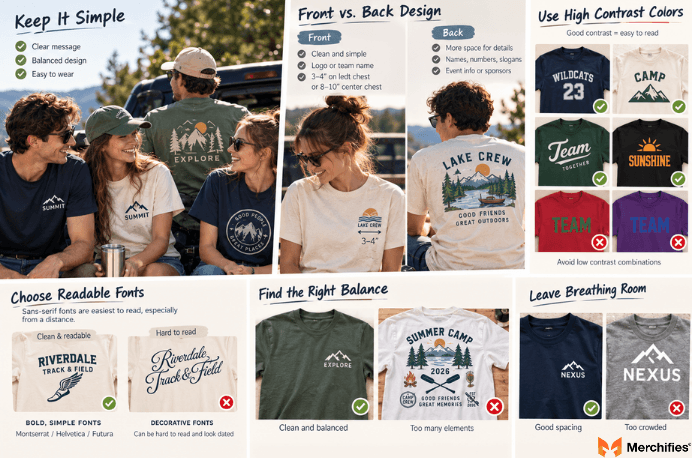
Keep front designs simple. A clean logo or team name with a small graphic reads better than a front covered with text, sponsors, and competing visual elements. If you have required elements (sponsor logos, league identifiers), designate clear zones and don't let them crowd each other.
Back design offers more real estate for complexity—names, numbers, slogans, sponsor blocks, commemorative text. For sports teams, prioritize number and name visibility at distance. For event shirts, backs often carry participant lists, dates, or extended graphics. For corporate teams, backs might include company taglines, website URLs, or department identifiers. Our detailed guide on what to put on the back of a team shirt covers creative options and spacing considerations in depth.
As Lucas Bennett notes, color theory fundamentals apply directly to shirt design decisions. High contrast between print color and shirt color ensures readability—white or light yellow on dark shirts, black or dark blue on light shirts. Avoid placing red text on green shirts or blue text on purple shirts where colors compete rather than contrast. Team colors should drive shirt selection, but adjust print colors if needed to maintain legibility.
Typography determines whether your text communicates or confuses. Sans-serif fonts (like Helvetica, Arial, or Futura) read more easily at distance than decorative scripts or serif fonts. Avoid trendy novelty fonts that will look dated within a few years—team shirts often get worn for years after creation. If your team name or event title requires a specific font, ensure it reproduces cleanly at print size; fine details disappear in small prints or get muddy in larger ones.
Balance means distributing visual weight so shirts don't feel lopsided or chaotic. If your front has a logo on the left chest, your back design should center or balance that asymmetry. If you're including sponsor logos, size them consistently so none dominates inappropriately. Leave breathing room around elements—cramped designs feel cheaper than designs with intentional white space.
The honest trade-off for design: if you want to include everything—all sponsors, all participant names, multiple graphics, event details, team history—you'll need to accept a busier shirt that some people find overwhelming. You cannot have maximum information and clean aesthetics without making the shirt larger or splitting content across front and back strategically.
The ordering process creates more problems than design work for most team shirt projects—sizing collection, quantity decisions, and timeline management require advance planning. Teams that skip these logistics often end up with shirts that don't fit, arrive late, or cost more than budgeted.
Collecting sizes from a group requires persistence since people delay responding and forget requests. Create a simple form (Google Forms works well) with sizing options and a firm deadline. Include a link to the size chart—not just sizes, but actual measurements in inches. Ask respondents to measure a shirt that fits them well rather than guessing at size labels, which vary across brands. Set your response deadline at least a week before you need to finalize the order, then follow up individually with non-responders.
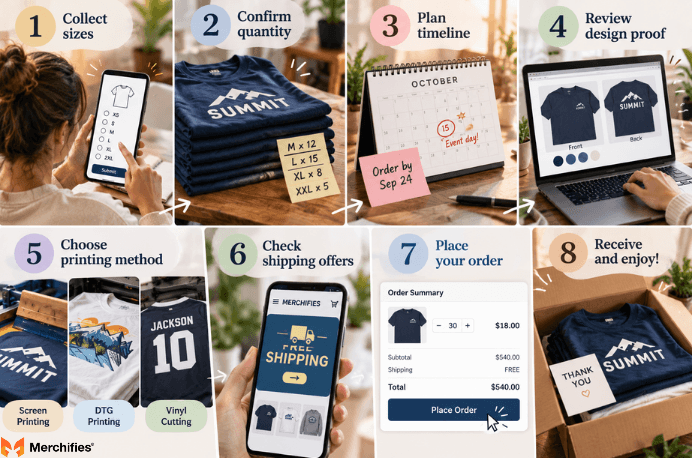
Ordering buffer prevents the frustration of missing shirts for people who join late, sizing errors, and unexpected needs. Add 5-10% extra shirts across popular sizes (typically medium, large, XL). For teams with volatile membership, lean toward 10%. For stable groups with confirmed sizes, 5% suffices. These extras cost relatively little compared to placing a second small order later, which typically carries higher per-unit costs and additional shipping.
Timeline planning prevents rush fees and delivery anxiety. Standard production runs typically take 2-3 weeks from order placement to delivery. Rush options exist (5-7 business days from many providers) but cost premium fees. Print-on-demand services like Merchifies often ship within 3-5 business days since there's no bulk production queue, making them practical for tighter timelines. Work backward from your need-by date: if you need shirts for an event on October 15th, place orders by September 24th to allow standard production time plus shipping buffer.
Proof approval represents your last chance to catch errors before production. Review every detail: spelling of names, number accuracy, logo placement, color specifications. Have someone who wasn't involved in the design review the proof with fresh eyes—familiarity blinds you to obvious mistakes. Most providers require explicit proof approval before printing, which protects both parties but means delays if you're slow to respond.
Bulk pricing tiers and minimum order considerations affect your cost structure. Traditional screen printers typically require minimums of 12-24 shirts and offer better per-unit pricing at higher quantities (50+, 100+, 250+ price breaks). If your team needs fewer than the minimum, you'll either pay minimums for shirts you don't need or seek alternatives. Print-on-demand services eliminate minimums entirely—order exactly the quantity you need, from one shirt to hundreds. The per-unit cost is higher than bulk pricing at scale, but there's no waste, no inventory risk, and no minimum threshold to meet.
To check current free shipping offers , visit our shipping deals page before placing your order—timing your purchase with free shipping promotions can offset some of the per-unit cost difference compared to bulk pricing.
Decision factors to weigh before ordering: How many shirts do you actually need? How tight is your timeline? How complex is your customization (simple logo vs. individual names and numbers)? What's your total budget, and does bulk pricing or per-unit POD pricing work better for your quantity?
First-time team shirt orders consistently hit the same problems—mistakes that experienced organizers learn to prevent but newcomers don't anticipate. Understanding these pitfalls before ordering saves money, frustration, and the disappointment of shirts nobody wants to wear.
Wrong fabric for activity level creates uncomfortable players and premature wear. Cotton shirts for a summer soccer league mean sweaty, clingy jerseys by halftime. Performance fabric for a casual corporate team-building retreat might feel overdressed and unnecessarily athletic. Match fabric to intended use: performance poly-blends for actual athletics, soft cotton blends for casual occasions, structured cotton-poly for professional settings.
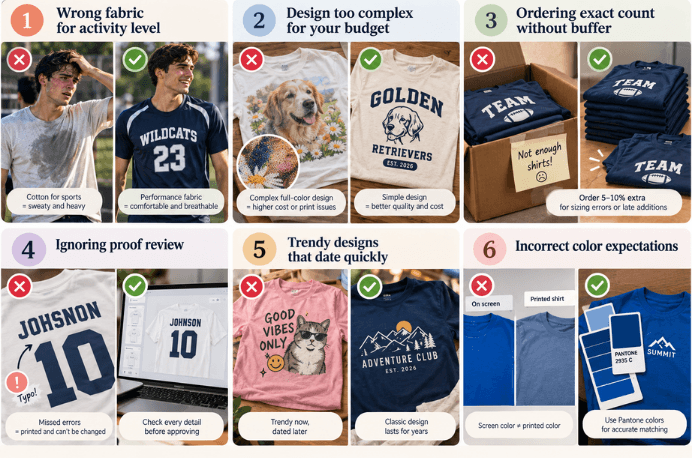
Design too complex for print method budget leads to sticker shock or compromised artwork. A full-color photographic design looks stunning on screen but costs significantly more to screen print than a simple two-color logo—or requires switching to DTG printing with different fabric requirements. If budget is fixed, simplify the design to match. If the design is non-negotiable, adjust budget expectations. Having this conversation before finalizing artwork prevents disappointment.
Ordering exact count without buffer for sizing errors or late additions guarantees someone ends up without a fitting shirt. People guess wrong on sizes, new members join after orders are placed, and someone always needs one more shirt at the last minute. The 5-10% buffer rule exists because it consistently prevents these problems.
Ignoring proof review is the most preventable mistake. Typos in names ("Johsnon" instead of "Johnson"), numbers assigned to wrong players, logos placed upside down, wrong shirt color selected—all of these reach production when people approve proofs without careful review. Print providers won't catch these errors; that's not their job. Assume the proof is wrong and verify every detail before approving.
Choosing trendy designs that date quickly makes sense for one-time events but backfires for ongoing teams. A design featuring current viral memes or highly specific pop culture references looks fresh in September 2026 but dated by September 2027. For teams that will wear shirts across multiple seasons, classic designs with timeless elements last longer and age more gracefully. Save the trendy stuff for event shirts designed to commemorate a specific moment.
Forgetting to check color accuracy between screen and print leads to shirts that don't match expectations. The blue you see on your monitor may not match the blue your printer produces, which may not match the blue in your existing brand materials. If color precision matters, specify Pantone colors rather than describing colors or sharing RGB/CMYK values. Request physical color swatches or samples if exact matching is critical.
Three primary options exist for custom team shirt production: local print shops, online custom apparel platforms, and print-on-demand services—each with distinct advantages depending on your order profile. The right choice depends on quantity, timeline, customization needs, and your comfort level with online versus in-person ordering.
Local print shops offer hands-on service that online alternatives can't match. You can visit the shop, see samples of their work, discuss design details in person, and resolve issues through direct conversation. Proofing typically happens quickly since you're working with a local team who can show you physical samples. The trade-offs: local shops often have limited shirt selection compared to online platforms, higher minimums than print-on-demand services (typically 24+ pieces), and potentially higher prices for smaller orders. Turnaround can be faster for simple jobs since there's no shipping delay, but production capacity may be more limited than industrial online operations.
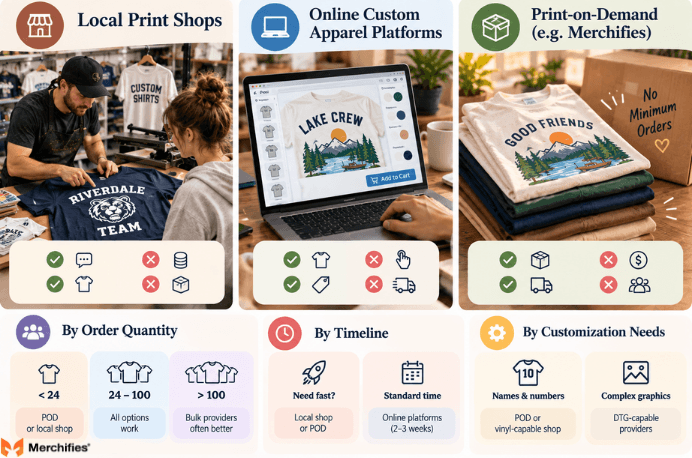
Online custom apparel platforms like CustomInk, RushOrderTees, and similar services combine broad selection with pricing tools that help you estimate costs for different quantities and methods. These platforms typically offer bulk discounts at volume tiers, a wide variety of shirt brands and styles, and streamlined design tools for uploading or creating artwork. The trade-offs: you can't touch fabric before ordering (though some offer samples), design support happens through chat or phone rather than in-person, and shipping adds lead time. Minimum orders are typically lower than local shops but still apply for screen printing.
Print-on-demand services represent the third option, producing shirts individually as ordered rather than in bulk runs. This model eliminates minimum orders entirely—you can order one shirt or one hundred. Setup is simpler since POD services handle inventory and production logistics automatically. No leftover inventory risk exists for event shirts or experimental designs. Merchifies operates in this space, offering no minimum orders, a variety of apparel styles, and free shipping availability—making it particularly practical for small teams, events with uncertain attendance, or situations where you're testing designs before committing to larger orders.
The trade-off with POD: per-unit cost runs higher than bulk pricing for large orders. If you need 200 identical shirts on a tight budget, traditional bulk printing from a local shop or online platform delivers better unit economics. But if you need 15 shirts with individual names, POD handles the personalization efficiently. If you're not sure how many shirts you need, POD flexibility prevents costly overordering.
Decision framework: Order size drives the primary decision. Under 24 shirts? POD or find a local shop willing to work below typical minimums. 24-100 shirts? All three options work—compare pricing and timeline. Over 100 shirts? Bulk providers likely offer better unit economics, but verify that POD alternatives aren't competitive for your specific configuration.
Timeline urgency affects the choice. Local shops and POD services often deliver faster than large online platforms for small to medium orders. If you need shirts in under a week, call local shops and check POD delivery estimates—bulk online platforms rarely hit rush timelines without premium fees.
Customization complexity matters. Individual names and numbers favor POD or vinyl-capable local shops. Simple identical logos suit any option. Complex full-color graphics push toward DTG-capable providers, whether local or online.
Drawing on Lucas Bennett's work with custom apparel sourcing, the most common ordering mistake is assuming one provider type works for all situations. Smart organizers match the provider to the specific order profile rather than defaulting to familiar options.
For readers ready to explore options, browse Merchifies' collection—including team tees, performance styles, and customizable blank options—to find the style that matches your design vision and group needs.
-d4c38c342cdf20ca.jpeg)


-b555fcc6b204c456.jpeg)