 Worldwide Shipping
 Secure Payments
 Free Return
 Local Support
-da0801079a650a2e.jpeg)
17 Year Anniversary Quotes: 110+ Funny, Romantic & Furniture Wishes (2026)
Mar, 12 2026
Find creative unique Halloween costumes organized by effort level—from clever wordplay concepts requiring zero DIY to ambitious builds that guarantee you're the only one at the party with your look.
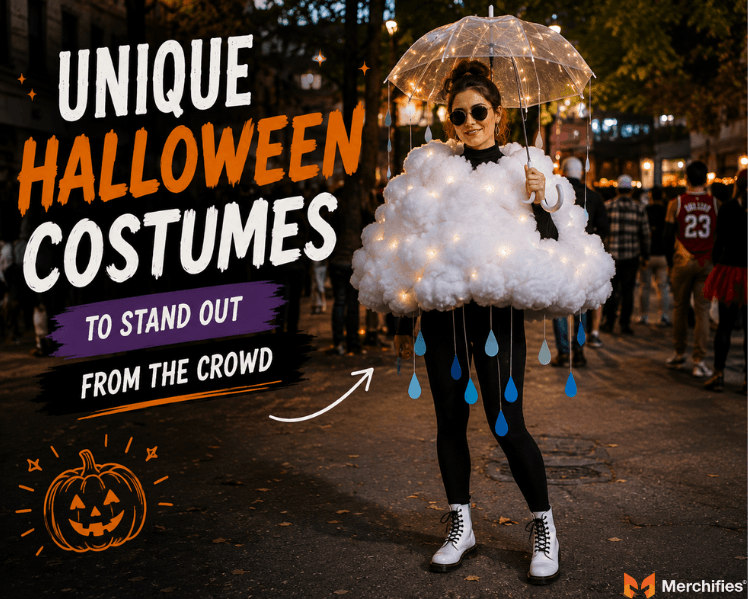
According to Cameron Foster's research into memorable costume strategies, truly unique Halloween costumes share one trait: they make people stop, smile, and ask "what are you?" without already knowing the answer. The difference between showing up as yet another vampire and arriving as something genuinely original isn't budget or crafting skill—it's concept. In 2026, the most memorable costumes at any party will be the ones that started with a clever idea, not just a trip to the seasonal store. This guide organizes unique Halloween costumes by your actual constraints: how much time you have, how crafty you feel, and whether you're flying solo or coordinating with a group.
Here's what separates standout costumes from the crowd:
Concept-driven ideas beat expensive materials every time
Effort level matters less than cleverness of execution
The best unique costumes spark conversations naturally
A simple base layer plus one strong prop often outperforms elaborate builds
A costume qualifies as unique when fewer than three other people at a 50-person party could reasonably show up wearing the same thing. That's the practical threshold. Mass-produced popular costumes—the ones filling seasonal store aisles—fail this test by design. They're manufactured for volume, which means you're competing with everyone who grabbed the same package.
Three strategies consistently produce unique Halloween costumes that pass the threshold:
Obscure references. Pick something from a niche interest, a B-movie, or a regional inside joke. The narrower the reference pool, the lower your collision risk.
Clever wordplay. Puns and visual jokes require explanation, which guarantees conversation. Being a "ceiling fan" (someone wearing a sports jersey that says "Go Ceiling!") reads as instantly creative.
Unexpected mashups. Combine two concepts that don't belong together. Victorian astronaut. Medieval tourist with a fanny pack and selfie stick. The cognitive dissonance makes people look twice.
Before choosing your direction, run a quick self-assessment: How comfortable are you being the center of attention? What's your DIY skill level—honestly? And what's your realistic budget? A $15 wordplay costume that fits your personality beats a $150 elaborate build you'll feel awkward in all night.
The honest trade-off: if you want maximum uniqueness, you'll need to accept some people won't immediately recognize your costume. You cannot fully have both instant recognition and true originality without picking a very specific sweet spot.

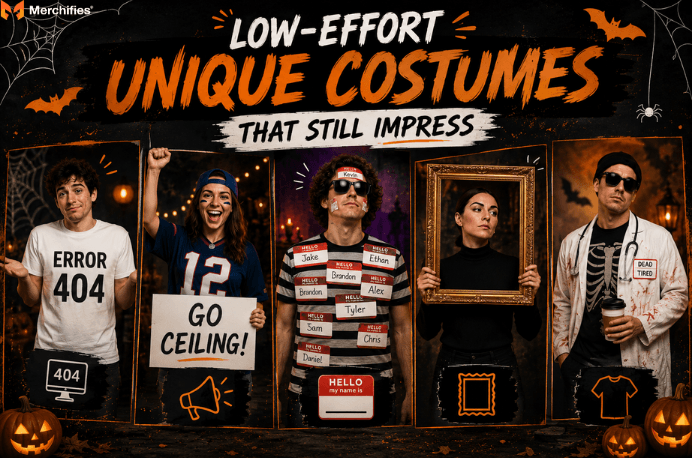
The most effective low-effort costumes rely on clever concepts that require minimal assembly but maximum wit. These work perfectly for last-minute planners or anyone who'd rather spend energy on party conversation than craft projects.
Wordplay concepts that work every time:
Error 404: Costume Not Found. White shirt with "Error 404" printed or written on it. Done. Tech-literate crowds especially appreciate this one.
Ceiling Fan. Wear any sports jersey, carry a sign that says "Go Ceiling!" Cheer enthusiastically for ceilings whenever prompted.
Identity Thief. Cover yourself in "Hello My Name Is" stickers with different names. Add a striped shirt for visual shorthand.
Self-Portrait. Cut a frame from cardboard, hold it around your face, wear all black. Bonus points for adopting a deadpan museum expression.
Here's where a themed Halloween t-shirt becomes genuinely useful: it provides an instant costume foundation without any crafting. Merchifies carries Halloween t-shirts in multiple designs that work as complete statements or starting points. Pair one with a single prop—a skeleton tee plus a doctor's coat becomes "dead tired medical resident"—and you've built something original in under five minutes.
These costumes fit best for: people who'd rather invest in the concept than the construction, anyone deciding on costume day, and folks who want to stay comfortable while still getting compliments.
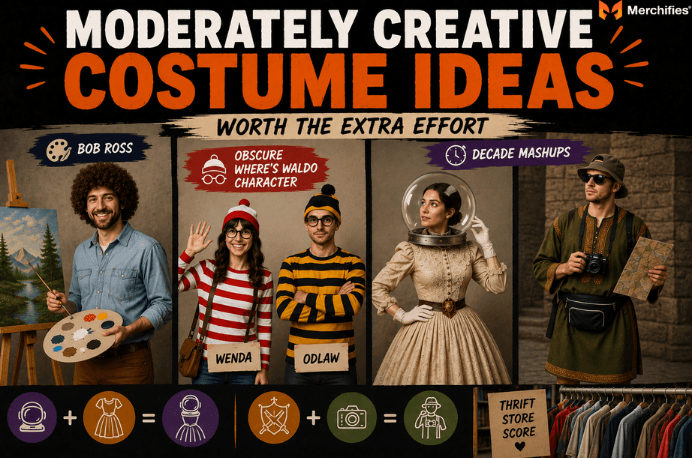
Costumes in this tier require weekend assembly or a thrift store run but reward that effort with genuine memorability. Plan for 1-2 weeks of lead time and expect to spend $25-50 on materials.
Thrift-assembly ideas that consistently work:
Bob Ross. Thrift a denim shirt and brown pants, buy a cheap afro wig, carry a palette with "happy little trees." The beard sells it.
Obscure Where's Waldo character. Everyone knows Waldo—but Wenda? Odlaw? The wizard Whitebeard? Same visual language, zero competition.
Decade mashup. Victorian astronaut works by pairing a thrifted old-fashioned dress or suit with a DIY space helmet from a fishbowl. Medieval tourist: tunic plus fanny pack, camera, and white sneakers.
Unexpected mashup execution tips:
Pick two concepts from completely different eras or contexts
Identify the single most recognizable element of each (astronaut helmet, tourist camera)
Combine those elements on one outfit without overthinking the rest
Thrift store strategy matters here. Go early in October—selection drops fast after the 15th. Check the women's section regardless of your gender; formal wear and costume-ready pieces land there more often. Budget $15-25 for base pieces and save the rest for props that sell the concept.
These costumes fit best for: people who enjoy the hunt, anyone with access to a decent thrift store, and costume enthusiasts who want uniqueness without going full DIY.
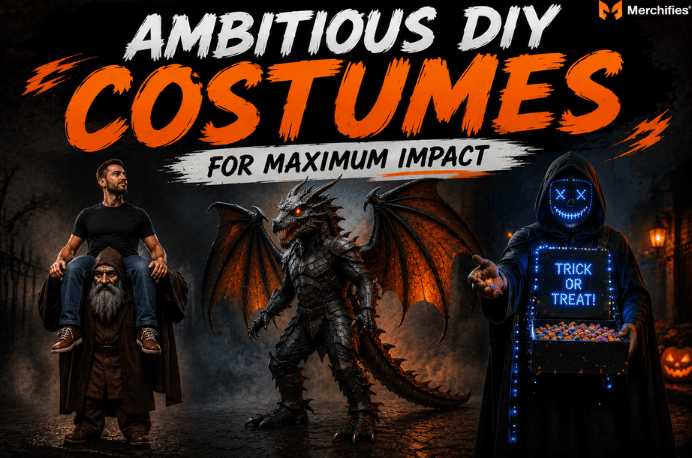
Elaborate builds guarantee uniqueness but require genuine commitment—start three or more weeks before Halloween and expect to spend $75-150 on materials.
Ideas worth the investment:
Optical illusion costumes. The "carrying yourself" illusion or split-body designs read incredibly in photos and require structural planning.
Elaborate creature builds. Wings that move, tails that articulate, heads that turn. These need armature work and test runs.
Interactive elements. Costumes that dispense candy, light up responsively, or make sounds when triggered create experiences, not just appearances.
Timeline for ambitious builds:
Week 1: Concept finalization and material list
Week 2: Material sourcing—check craft stores, online suppliers, and hardware stores for structure elements
Week 3: Construction and initial assembly
Week 4: Test run at home, fix mobility issues, practice wearing it for extended periods
Budget reality: expect to exceed initial estimates. Structural materials (PVC, foam core, wire armatures) add up faster than fabric. Build in a 20% buffer.
These costumes fit best for: dedicated costume enthusiasts with crafting experience, people with storage space for construction, and anyone who views the build itself as part of the fun. Not recommended for last-minute planners or folks who need high mobility all night.
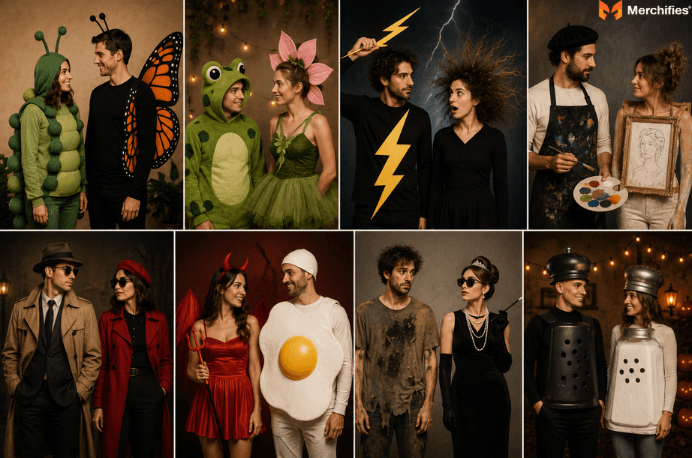
The best couples costumes go beyond matching outfits into concepts that require both people to make sense. Salt and pepper are fine. Before-and-after concepts are better.
Ideas that coordinate without being boring:
Before/after concepts. Caterpillar and butterfly. Tadpole and frog. Seed and flower. One person represents the earlier state, the other the transformation.
Cause and effect. Lightning bolt and someone with frizzy shocked hair. Painter and unfinished canvas.
Obscure duo references. Pull from niche films, regional mascots, or inside jokes only your friend group gets. The confusion from strangers is part of the fun.
Punny pairs. Formal apology (one person in formal wear, the other with "Sorry" signs). Deviled eggs (one devil, one egg).
Coordination tips that prevent the "which one are you?" problem:
Match color palettes loosely rather than exactly. Complementary costumes don't need to be matchy—they need to clearly belong together. Make sure both costumes are equally recognizable; nothing's worse than one partner getting all the attention while the other explains their half repeatedly.
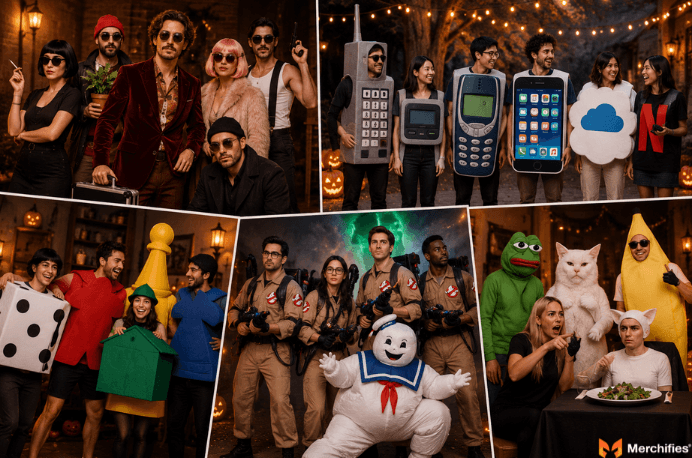
Group costumes succeed when they establish immediate visual unity while giving each person a distinct character. The best themes let people identify the group from across the room while still appreciating individual interpretations up close.
Ideas for groups of 3-8:
Obscure movie ensembles. Skip the Avengers—everyone does that. Try the ensemble from a cult classic your group loves. Fewer people recognize it, but the ones who do become instant friends.
Evolution of a concept. Each person represents a different stage: flip phone to smartphone, VHS to streaming, handwritten letter to text message.
Niche hobby references. If your group shares an interest—board games, a specific video game, a sport—go deep into that reference pool.
Meme adaptations. Pick something viral from 2026 and assign different versions or roles to each person.
Planning logistics for groups:
Assign roles based on personality and body type comfort—nobody should feel stuck with a character they can't embody
Establish a color scheme early so the group reads as unified even if individual costumes vary
Create one recognition element everyone shares (same accessory, same color accent, same prop style)
For groups coordinating across different cities or schedules, matching themed shirts create instant cohesion without requiring everyone to DIY the same thing. Merchifies Halloween t-shirts work well here—order the same design for the crew, then let everyone customize their bottom half and accessories. The shared base reads as intentional coordination; the individual additions let personalities show through.
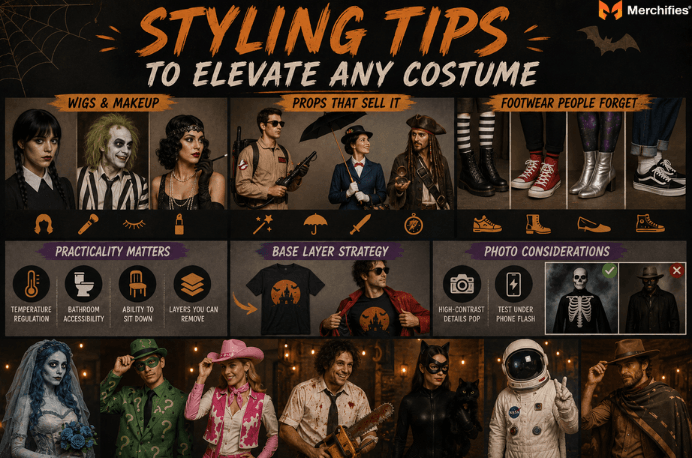
Accessories and styling details separate good costumes from memorable ones—the difference between "I see what you're going for" and "that's incredible."
What completes a costume:
Wigs and makeup. Even a basic costume transforms when the hair and face commit to the concept. Budget wigs work fine when styled deliberately.
Props that sell it. One well-chosen prop often matters more than elaborate costume construction. Carry something interactive if possible—gives people reason to approach you.
Footwear people forget. Plan for comfort if you'll be standing or dancing for hours. Sneakers that match your color scheme beat thematically perfect shoes that destroy your feet.
As Cameron Foster notes, the most common mistake with ambitious costumes is ignoring practicality: temperature regulation, bathroom accessibility, and the ability to sit down all matter more than they seem at 6 PM. Build in layers you can remove.
Base layer strategy: comfortable graphic tees anchor unique costumes while keeping you functional all night. A Halloween-themed shirt from Merchifies works as both costume foundation and backup plan—if your elaborate prop breaks or gets inconvenient, you're still dressed for the occasion.
Photo considerations: costumes read differently in photos than in person. High-contrast details photograph better than subtle textures. Test your costume under phone flash before the event.
The window for trend-based costumes is narrow—recognizable enough that people get the reference, but not so saturated that fifteen other partygoers had the same idea.
Strategy for hitting the trend window: look at what peaked in cultural conversation between January and August 2026. Films released in early 2026, viral moments from spring and summer, emerging aesthetics that feel fresh but established. By October, anything from late 2025 or earlier risks feeling dated; anything from September 2026 might be too new for widespread recognition.
Categories to watch for 2026 references:
Breakout characters from early 2026 streaming releases
Viral fashion moments or meme-worthy red carpet looks
Internet-native references that crossed over to mainstream awareness
Political or cultural moments that work as costumes without causing offense
Caution: avoid costumes that punch down, require explaining why they're not offensive, or rely on controversy for recognition. The attention isn't worth the explanations—or the social media photos that age poorly. When in doubt, test the concept with someone outside your immediate friend group.
Drawing on Cameron Foster's work with seasonal costume trends, the safest approach is choosing references that make people smile rather than wince. Nostalgia callbacks to early 2000s or 2010s content also work well in 2026—far enough away to feel retro, recent enough that everyone remembers.
For anyone still deciding, our complete Halloween costume guide for 2026 covers broader style categories beyond the uniqueness focus here—helpful if you're still narrowing down your direction. And when you've landed on a concept that needs a solid foundation piece, browse Merchifies Halloween t-shirts —including skeleton designs, spooky graphics, and seasonal statement pieces—to find the base layer that anchors your look.
-d4c38c342cdf20ca.jpeg)


-b555fcc6b204c456.jpeg)