 Worldwide Shipping
 Secure Payments
 Free Return
 Local Support
-da0801079a650a2e.jpeg)
17 Year Anniversary Quotes: 110+ Funny, Romantic & Furniture Wishes (2026)
Mar, 12 2026
Find the right wedding ceremony script for your celebration style—traditional, modern, or interfaith. Includes sample wording, timing estimates, and personalization tips to create a meaningful ceremony.
A wedding ceremony script is the complete spoken framework that guides every moment from the welcome to the final kiss.Whether you're officiating for friends, planning your own vows, or coordinating as a wedding planner, the script determines the tone, pacing, and emotional arc of the entire celebration. As of summer 2026, couples increasingly blend traditional structure with personal touches—making a flexible, style-appropriate script more valuable than a rigid template. The right script matches your venue, your values, and the story only you two can tell.
Key elements every wedding ceremony script contains:
Welcome and gathering (sets tone, acknowledges guests)
Readings or reflections (poems, passages, personal selections)
Vows and declarations (promises and "I do" statements)
Ring exchange (blessing words and partner exchange)
Pronouncement and closing (official declaration, first kiss)
A wedding ceremony script serves as the roadmap for your officiant, covering every spoken word from the opening welcome through the closing pronouncement.It's not just a list of what happens—it's the actual language your officiant will speak, the cues for vows, and the structure that keeps the ceremony flowing smoothly.
Core elements appear in virtually every script: a welcome or gathering statement, one or more readings, the exchange of vows, the ring ceremony, and the final pronouncement. Timing varies, but most ceremonies run 15 to 30 minutes depending on how many readings you include and whether you add a unity ritual.
Who uses these scripts? Ordained officiants, friends who got ordained online for the occasion, couples writing their own ceremony, and wedding planners who coordinate the flow. The timing estimates throughout this guide draw from standard officiant guidelines and ceremony planning benchmarks—practical averages, not rigid rules.
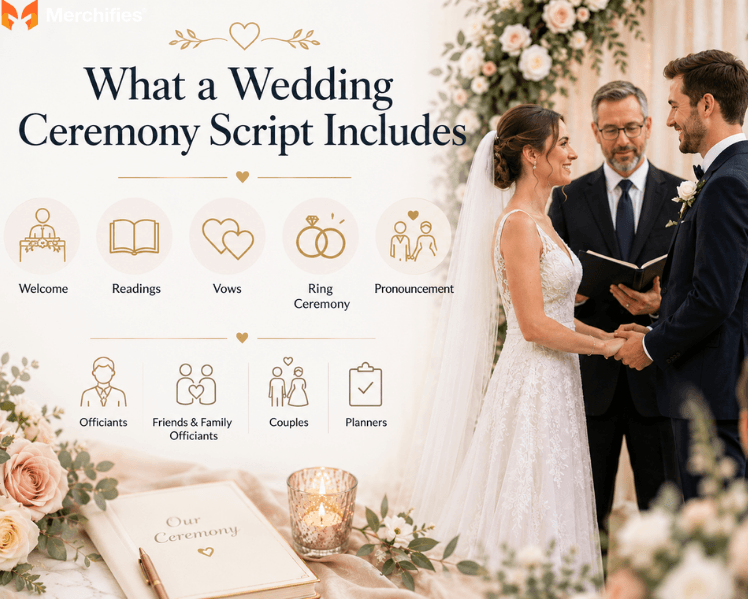
Every wedding ceremony script shares a universal structure, regardless of style or tradition.Understanding these building blocks helps you customize confidently without losing the flow that makes ceremonies feel complete.
Welcome and gatheringopens the ceremony, typically lasting 2 to 3 minutes. The officiant acknowledges guests, sets the tone (sacred, joyful, intimate), and creates the emotional space for what follows. A warm welcome grounds everyone in the moment.
Readings or reflectionsusually run 3 to 5 minutes. These can include religious passages, secular poems, quotes about love, or personal selections from friends or family. Some couples skip readings entirely; others include two or three. Your call.
Vows and declarationsform the emotional core, typically 5 to 7 minutes. This includes both the promises you make (traditional or personalized) and the "I do" statements. Personalized vows require more time than standard wording.
Ring exchangetakes 2 to 3 minutes. The officiant offers blessing words, then each partner speaks their ring exchange wording as they place the ring. Many couples use traditional phrasing here even when personalizing vows.
Pronouncement and closingwraps up in 1 to 2 minutes—the official declaration of marriage and the first kiss. This moment lands differently depending on how well the earlier sections built anticipation.
These elements form the universal framework. Your chosen style determines the specific wording within each section.
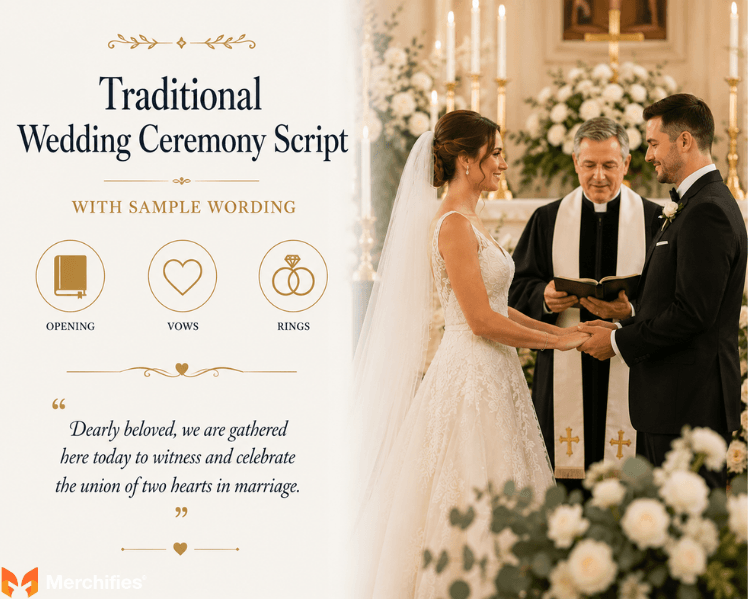
A traditional wedding ceremony script uses formal language and time-honored phrasing that has anchored ceremonies for generations.The tone is reverent, the structure familiar, and the language carries weight precisely because it echoes countless ceremonies before.
Sample opening:"Dearly beloved, we are gathered here today to witness and celebrate the union of [Name] and [Name] in marriage. This is a moment of great celebration, for the joining of two hearts that have found in each other a love worthy of a lifetime."
Traditional vow format:"I, [Name], take you, [Name], to be my wedded [spouse], to have and to hold from this day forward, for better, for worse, for richer, for poorer, in sickness and in health, to love and to cherish, until death do us part."
Ring exchange wording:"With this ring, I thee wed, and pledge my faithful love to you."
When does traditional work best? Formal venues, couples wanting timeless elegance, or situations where family expectations lean toward classic ceremony language. Traditional scripts carry an inherent gravitas that modern phrasing sometimes lacks.
One practical note: some traditional scripts—particularly religious versions—require a licensed officiant for legal validity. Check your state's requirements before assuming your friend can simply read the words.
Modern secular scripts replace formal religious language with conversational phrasing that feels personal and immediate.The structure remains the same, but the tone shifts toward warmth and authenticity over formality.
Sample opening:"Welcome, everyone. We're here today because [Name] and [Name] have found something extraordinary in each other—a partnership built on laughter, respect, and the kind of love that makes ordinary days feel remarkable."
Modern scripts often spotlight the couple's unique story: how they met, what they love about each other, shared values, or specific memories. This narrative approach creates intimacy that traditional language doesn't attempt.
Modern vow example:"I choose you today, and I will choose you every day. I promise to be your partner, your confidant, and your biggest supporter. When life gets hard, I promise to face it beside you—never behind you, never ahead, but together."
When does modern secular work best? Non-religious couples, outdoor or casual venues, and celebrations where personalization matters more than tradition. Modern scripts also accommodate unity ceremonies like sand blending, wine box rituals, or handfasting—symbolic gestures that traditional scripts rarely include.
The honest trade-off: if you want deeply personal wording, you sacrifice the automatic gravitas that "dearly beloved" carries. You cannot fully have both without careful balance.
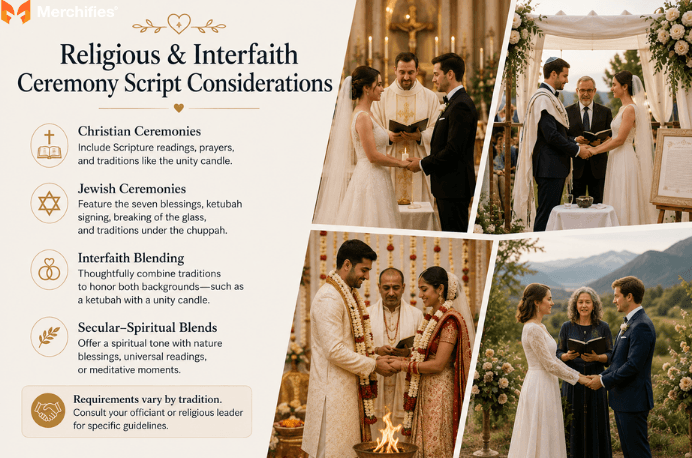
Religious ceremony scripts follow denominational requirements that shape both structure and language.Interfaith ceremonies require thoughtful blending to honor both traditions without awkward collisions.
Christian ceremoniestypically include Scripture readings, prayers, and sometimes a unity candle. Specific denominational requirements vary—Catholic ceremonies, for instance, have different structural expectations than Baptist ones.
Jewish ceremoniesincorporate the seven blessings, breaking of the glass, ketubah signing, and traditions performed under the chuppah. The structure differs significantly from Christian formats.
Interfaith blendingrequires creative balance. A Jewish-Christian ceremony might include both a ketubah and a unity candle. A Hindu-Christian ceremony could incorporate the garland exchange alongside Western vows. The goal is honoring both backgrounds without creating a disjointed ceremony.
Secular-spiritual blendserves couples who want spiritual tone without specific religious affiliation. Nature blessings, universal spiritual readings, or meditative moments provide reverence without doctrine.
Required elements vary by denomination and tradition. If you want your ceremony recognized within a faith community, consult your officiant or religious leader for specific requirements. Some religious ceremonies require ordained clergy—not just someone who got ordained online.
Personalization transforms a generic wedding ceremony script into a reflection of your specific relationship.The key is knowing where personal touches strengthen the ceremony and where they disrupt flow.
Best places for personal touches:reading selection, vow content, unity ceremony choice, and the welcome message. These sections accommodate individuality without breaking the structural rhythm.
Story prompts for personalization:How did you meet? What moment made you know this person was different? What do you admire most about your partner? What do you want to build together? Answering these questions generates material for vows and officiant remarks.
Meaningful gestures add emotional depth: a family rose ceremony, wine blending, a memorial moment for loved ones who couldn't attend. Consider includingheartfelt wedding wishes and messages from family membersin your readings section—incorporating their words honors their role in your story.
Balance personalization with pacing. Aim for 2 to 3 personal elements maximum. Too many unique touches fragment the ceremony's rhythm and exhaust emotional attention.
Preserve your personalized vows and ceremony words in a custom vow book or printed keepsake program. A personalized vow book becomes a meaningful way to revisit your promises for years to come—far more lasting than a phone screenshot.
Ceremony timing determines whether your script feels rushed, meandering, or perfectly paced.Planning the right length prevents the awkwardness of running overtime or ending abruptly.
Total ceremony timing by style:
Intimate elopement: 10-15 minutes
Standard ceremony: 20-25 minutes
Full traditional with multiple readings: 30+ minutes
Pacing guidance:Slow down for vows—this is the emotional peak. Allow natural pauses for tears, laughter, or composure. Don't rush the ring exchange; let the moment breathe.
Coordinate with your venue timeline and photographer. They need to know when processional begins and when key moments (vows, kiss) will occur for positioning. Build in 3 to 5 minutes of buffer for unexpected moments—happy tears, spontaneous laughter, guest reactions. Ceremonies rarely run exactly as scripted.
Rehearsal importance:Run through the complete script at least once. This isn't about memorization—it's about timing confidence and smooth delivery. Your officiant needs to feel the rhythm of your specific ceremony.
AllMasterHub carries personalized ceremony programs and custom vow books in designs suited for both traditional and modern celebrations. Consider printing your ceremony script as a keepsake program for guests—or as a personalized thank-you gift for your officiant who made the day possible.
The script that works best is the one that sounds like you when spoken aloud. Read your final version out loud before the rehearsal. If any phrase makes you cringe or stumble, change it—you'll hear it in front of everyone who matters to you.
-d4c38c342cdf20ca.jpeg)

-b555fcc6b204c456.jpeg)