 Worldwide Shipping
 Secure Payments
 Free Return
 Local Support
-da0801079a650a2e.jpeg)
17 Year Anniversary Quotes: 110+ Funny, Romantic & Furniture Wishes (2026)
Mar, 12 2026
Find 50+ quotable quotes organized by life themes, each with context on why it resonates. Learn what makes lines memorable and how to use them in speeches, writing, and daily reflection.
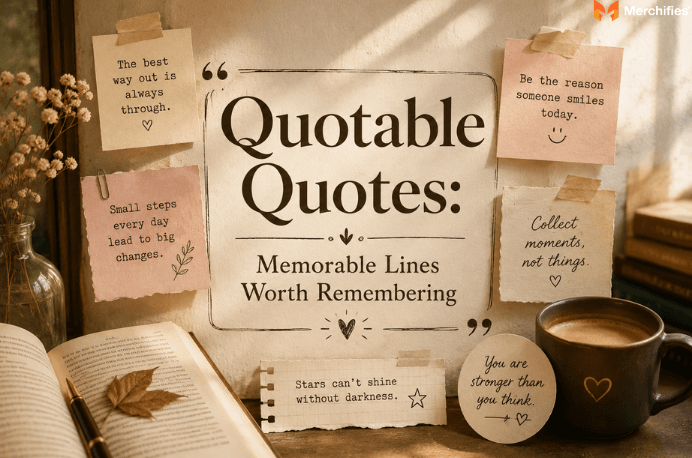
A quotable quote does something ordinary sentences cannot: it compresses a universal truth into so few words that you remember it years later without trying. The best lines stay with us because they combine brevity, rhythm, and a flash of insight that feels both surprising and obvious. In 2026, when information overload makes forgetting the default, understanding what makes certain words stick gives you an edge—whether you are preparing a speech, journaling through a difficult season, or simply looking for a phrase that captures what you already feel but could not articulate. Our team at AllMasterHub has spent considerable time curating and analyzing memorable quotes across dozens of themes, and this collection reflects that depth of research. What follows is not another database dump of famous quotations but a curated guide: we explain the mechanics of memorability, organize fifty-plus lines by life situation, and show you exactly how to remember and use them.
A quotable quote is a memorable line—typically under 25 words—that combines universal truth with striking language, making it easy to recall and worth repeating.
Brevity forces precision; the best quotes rarely exceed fifteen words
Rhythm and cadence make lines feel inevitable, almost musical
Surprise or reversal creates the "aha" that lodges in memory
Universal truth ensures the line resonates across generations
Quotable quotes share four qualities that separate them from ordinary sentences: brevity, rhythm, universal truth, and an element of surprise. Understanding these factors helps you select the best quotes to remember, recognize why certain famous quotations endure, and deploy them effectively in your own communication. Let us examine each quality with concrete examples, so you can identify memorable quotes on sight rather than relying on someone else's curation.
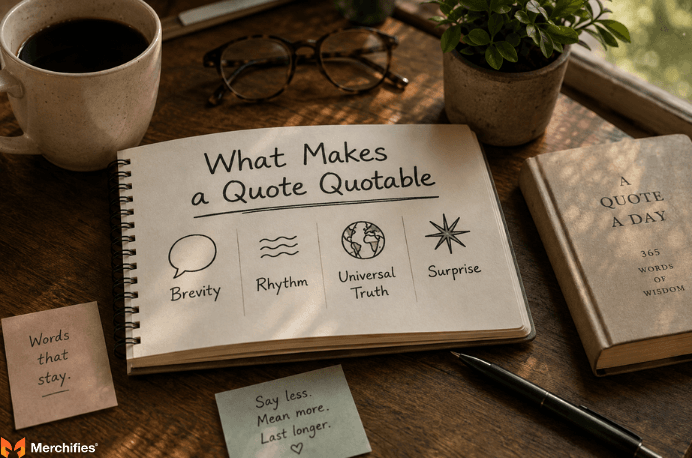
Brevity forces the speaker to compress meaning. Consider Oscar Wilde's observation: "Be yourself; everyone else is already taken." Nine words. No filler. The constraint itself sharpens the idea. Longer statements dilute impact because the brain must work harder to retain them. When you encounter a quotable quote, count the words—you will rarely find more than twenty, and the most viral lines often hover around ten.
Rhythm and cadence give memorable quotes their staying power. Winston Churchill understood this intuitively: "If you're going through hell, keep going." The parallel structure and punchy monosyllables create a beat you can almost tap. Rhythm transforms advice into something closer to music, and music is notoriously hard to forget. Read potential quotes aloud; if they feel clunky on your tongue, they will not stick in memory.
Universal truth ensures relevance across time and context. Marcus Aurelius wrote, "The happiness of your life depends upon the quality of your thoughts." Two thousand years later, the statement still applies because it addresses a permanent feature of human experience. Quotes tied to specific technologies, fashions, or political moments fade; those anchored in timeless psychology or ethics endure. This is why philosophers, poets, and spiritual teachers dominate any list of famous quotations—they dealt in universals.
Surprise or reversal creates the cognitive jolt that cements a line in memory. George Bernard Shaw quipped, "Youth is wasted on the young." The paradox forces a double-take, and that mental stumble is exactly what makes the phrase unforgettable. The best quotable quotes subvert expectation: they start in one direction and land somewhere unexpected, rewarding attention with insight.
When you combine these four qualities, you get lines that spread without marketing. Understanding the mechanics lets you filter the thousands of quotes you encounter online and keep only the ones genuinely worth remembering—and worth sharing with others who will remember them too.
Purpose-driven quotes address the internal search for direction rather than external markers of success. These memorable quotes suit graduation speeches, journaling prompts, and career crossroads—moments when someone needs perspective more than tactics. The following lines come from philosophers, authors, and modern thinkers who wrestled publicly with existential questions, giving their words extra weight.
"He who has a why to live can bear almost any how." — Friedrich Nietzsche. Viktor Frankl later expanded this idea in Man's Search for Meaning, making it a cornerstone of logotherapy. The quote endures because it reframes suffering as tolerable when purpose is present.
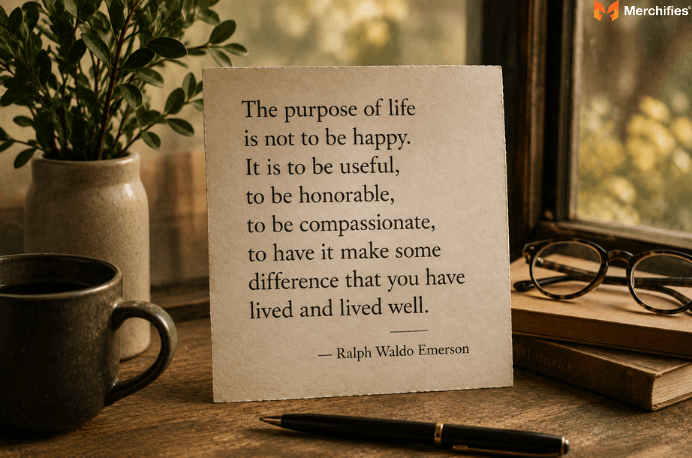
"The purpose of life is not to be happy. It is to be useful, to be honorable, to be compassionate, to have it make some difference that you have lived and lived well." — Ralph Waldo Emerson. At 36 words, this stretches the brevity rule, but its parallel structure and cumulative rhythm justify the length.
"In the middle of difficulty lies opportunity." — Albert Einstein. A tight reversal: difficulty typically signals obstacle, not opening. Einstein's framing shifts mindset in seven words.
"You are not a drop in the ocean. You are the entire ocean in a drop." — Rumi. The inversion elevates individual significance, making the quote popular in speeches about self-worth and spiritual identity.
Additional quotable quotes on purpose worth remembering: "The two most important days in your life are the day you are born and the day you find out why." (attributed to Mark Twain); "What lies behind us and what lies before us are tiny matters compared to what lies within us." (often attributed to Emerson); "Life is not about finding yourself. Life is about creating yourself." (George Bernard Shaw); "Act as if what you do makes a difference. It does." (William James).
Use purpose quotes when the audience faces a decision about direction rather than execution. They belong in commencement addresses, mentorship conversations, and personal reflections—not sales pitches or productivity workshops. The distinction matters: confuse purpose with success and you dilute both messages.
Resilience quotes acknowledge difficulty while affirming the possibility of endurance. They work as personal mantras during hard seasons, as motivational talk anchors, and as social media captions that signal grit without self-pity. The best quotes to remember in this category balance honesty about struggle with genuine encouragement.
"Success is not final, failure is not fatal: it is the courage to continue that counts." — Often attributed to Winston Churchill, though the exact origin is debated. Regardless of authorship, the parallel structure and alliteration make it instantly memorable.
"It does not matter how slowly you go as long as you do not stop." — Confucius. This quote reframes pace as irrelevant compared to persistence, offering comfort to anyone comparing their timeline to others.
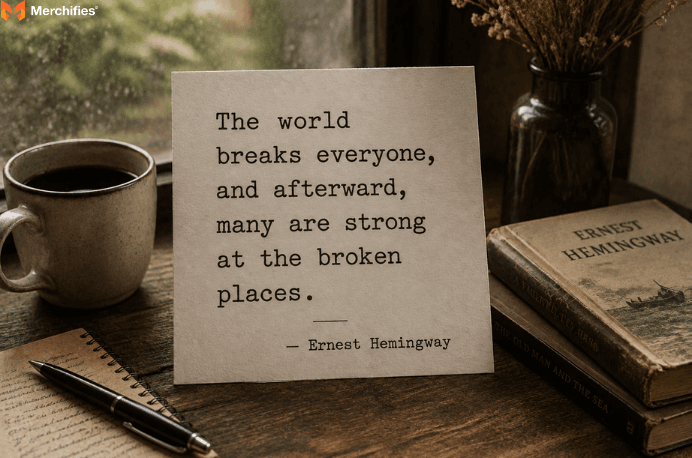
"The world breaks everyone, and afterward, many are strong at the broken places." — Ernest Hemingway, A Farewell to Arms. The imagery of strengthened fractures resonates because it validates scars while promising growth.
"I have not failed. I've just found 10,000 ways that won't work." — Thomas Edison. Reframing failure as data collection removes shame from the equation, making this a staple of entrepreneurship talks.
Additional famous quotations on resilience: "Fall seven times, stand up eight." (Japanese proverb); "What does not kill me makes me stronger." (Nietzsche); "Rock bottom became the solid foundation on which I rebuilt my life." (J.K. Rowling); "Courage is not having the strength to go on; it is going on when you don't have the strength." (attributed to Theodore Roosevelt); "The oak fought the wind and was broken, the willow bent when it must and survived." (Robert Jordan).
Resilience quotes shine when someone needs to push through rather than pivot. If the situation calls for strategic change, pivot advice works better; if it calls for sustained effort, these lines provide the internal fuel. The honest trade-off: perseverance quotes can tip into toxic positivity if delivered without acknowledging legitimate reasons to stop. Use them when the obstacle is internal doubt, not external signals that a path is genuinely blocked.
Love quotes capture the complexity of romantic bonds, friendships, and human connection in language that feels both intimate and universal. These memorable quotes suit wedding toasts, anniversary cards, and relationship reflections—moments when emotion runs high and borrowed eloquence feels appropriate rather than lazy. Favorite love quotes also make thoughtful personalized gifts, whether on a framed print for a newlywed couple or a custom keepsake for a close friend.
"The best thing to hold onto in life is each other." — Audrey Hepburn. Simple, warm, and short enough to fit on any keepsake item. Its appeal lies in prioritizing relationship over achievement.
"Love is composed of a single soul inhabiting two bodies." — Aristotle. Philosophers rarely get romantic, which makes this line stand out. The imagery of shared soul appeals to anyone seeking language for deep connection.
"Where there is love there is life." — Mahatma Gandhi. Six words, perfect parallelism. Gandhi's moral authority adds weight, but the line would resonate regardless of source.

"To love and be loved is to feel the sun from both sides." — David Viscott. The sensory metaphor transforms abstract emotion into physical experience, making the quote sticky.
Additional quotable quotes on love worth sharing: "In all the world, there is no heart for me like yours. In all the world, there is no love for you like mine." (Maya Angelou); "Whatever our souls are made of, his and mine are the same." (Emily Brontë, Wuthering Heights); "Love does not consist of gazing at each other, but in looking outward together in the same direction." (Antoine de Saint-Exupéry); "If I know what love is, it is because of you." (Hermann Hesse); "The giving of love is an education in itself." (Eleanor Roosevelt).
Wedding toasts benefit from one well-chosen quote rather than a string of them. Anniversary cards land harder when the quote feels discovered rather than obvious. And if someone in your life treasures a particular line, displaying it on a custom product—a mug, a print, a piece of apparel—turns ephemeral words into a daily reminder of connection.
Success quotes address external achievement, professional drive, and the pursuit of measurable goals. Unlike purpose quotes, which explore internal meaning, these famous quotations focus on outcomes—making them ideal for business presentations, goal-setting sessions, and mentorship conversations about career strategy. The best lines acknowledge ambition without ignoring its costs.
"Success usually comes to those who are too busy to be looking for it." — Henry David Thoreau. The reversal works: chasing success directly often backfires, while immersion in meaningful work attracts it incidentally.
"The only way to do great work is to love what you do." — Steve Jobs, 2005 Stanford commencement address. The line is widely quoted because it simplifies a complex trade-off into an aspirational statement. Whether fully true or not, it captures an ideal that motivates.
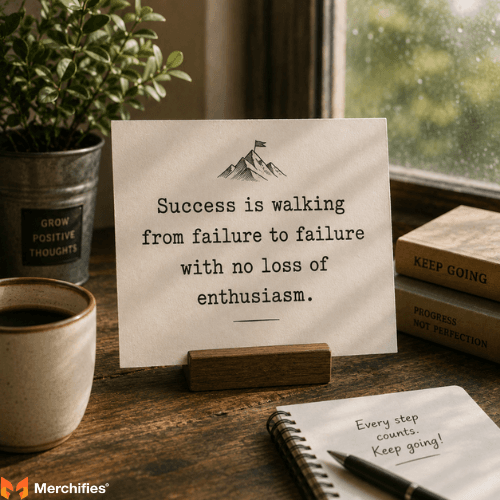
"Success is walking from failure to failure with no loss of enthusiasm." — Attributed to Churchill, though likely apocryphal. The structure mirrors resilience quotes, but the framing explicitly names success as the destination.
"I find that the harder I work, the more luck I seem to have." — Thomas Jefferson (attribution debated). The line appeals to anyone who suspects luck is not random, offering a controllable variable in an uncertain equation.
Additional memorable quotes on success: "Success is not the key to happiness. Happiness is the key to success." (Albert Schweitzer); "Don't be afraid to give up the good to go for the great." (John D. Rockefeller); "Opportunities don't happen. You create them." (Chris Grosser); "The secret of success is to do the common thing uncommonly well." (John D. Rockefeller Jr.); "Do not be embarrassed by your failures. Learn from them and start again." (Richard Branson).
Not every ambition quote ages well. Some glorify hustle culture without acknowledging burnout, and others assume linear paths that rarely exist in practice. Choose success quotes that leave room for nuance—and balance them with purpose quotes so audiences do not walk away believing external achievement is the only metric that matters.
Change quotes reframe uncertainty as opportunity rather than threat. They resonate during new year reflections, life transitions, and coaching conversations where someone needs permission to evolve. The best quotes to remember in this category validate discomfort while affirming that growth lies on the other side. For more short, punchy lines that deliver maximum impact, explore our short quotes that pack a punch .
"The only way to make sense out of change is to plunge into it, move with it, and join the dance." — Alan Watts. The dance metaphor transforms change from obstacle to partnership.
"When we are no longer able to change a situation, we are challenged to change ourselves." — Viktor Frankl, Man's Search for Meaning. This quote distinguishes external control from internal agency, offering a path when circumstances feel fixed.
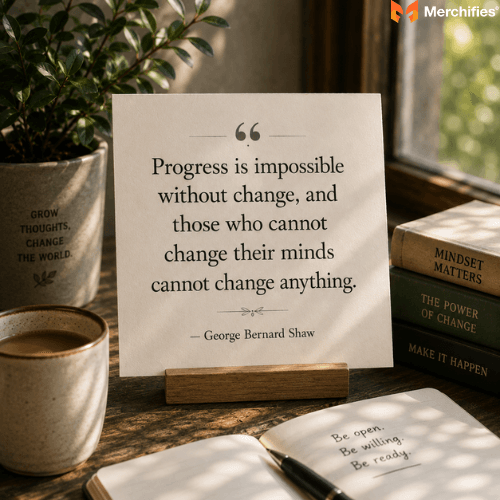
"Progress is impossible without change, and those who cannot change their minds cannot change anything." — George Bernard Shaw. Shaw ties progress explicitly to cognitive flexibility, challenging stubbornness as a virtue.
"Growth is painful. Change is painful. But nothing is as painful as staying stuck somewhere you don't belong." — Mandy Hale. The comparative framing validates discomfort while making stagnation the greater threat.
Additional quotable quotes on change: "Life is about change. Sometimes it's painful. Sometimes it's beautiful. But most of the time, it's both." (Lana Lang, Smallville); "You cannot step into the same river twice." (Heraclitus); "Change is the law of life. And those who look only to the past or present are certain to miss the future." (John F. Kennedy); "The measure of intelligence is the ability to change." (Albert Einstein); "Every next level of your life will demand a different you." (Leonardo DiCaprio).
Change quotes work best at transition points: job changes, relocations, relationship endings, personal reinventions. They lose power if delivered when someone has already committed to a path and needs execution advice rather than permission to shift.
Happiness quotes address joy, contentment, and the practice of appreciating what already exists. They belong in gratitude journals, thank-you notes, and daily affirmations—contexts where reflection matters more than action. Displaying favorite happiness quotes on a mug, desk print, or morning routine board turns abstract sentiment into daily reminder, reinforcing the mindset shift that gratitude research supports. For more uplifting lines to start your day, browse our positive quotes for daily motivation .
"Happiness is not something ready-made. It comes from your own actions." — Dalai Lama. The statement assigns agency, countering the myth that happiness arrives externally.
"The greatest wealth is to live content with little." — Plato. Ancient wisdom that still cuts against consumerism, making it relevant in any era of material excess.
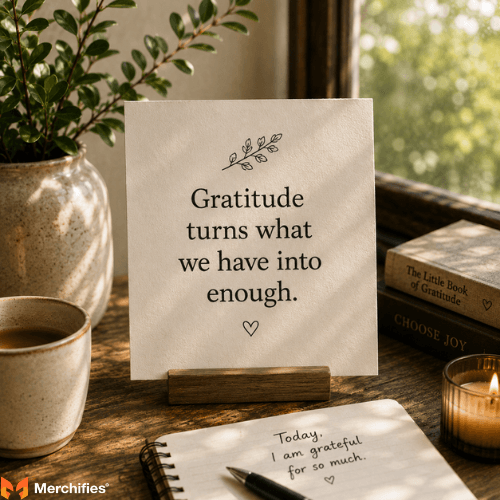
"Gratitude turns what we have into enough." — Anonymous, though often attributed to Melody Beattie. The brevity and rhyme make it sticky, and the insight is actionable: gratitude reframes scarcity.
"Enjoy the little things, for one day you may look back and realize they were the big things." — Robert Brault. The reversal lands because hindsight often confirms it; small moments become treasured memories.
Additional famous quotations on happiness: "The purpose of our lives is to be happy." (Dalai Lama); "Happiness depends upon ourselves." (Aristotle); "For every minute you are angry you lose sixty seconds of happiness." (Ralph Waldo Emerson); "Count your age by friends, not years. Count your life by smiles, not tears." (John Lennon); "Think of all the beauty still left around you and be happy." (Anne Frank).
Happiness quotes pair well with gift-giving occasions. A custom print featuring a loved one's favorite gratitude line transforms words into a tangible keepsake—a thoughtful gesture that costs little but signals attention. If you have a quote that anchors your morning routine, keeping it visible reinforces the habit better than relying on memory alone.
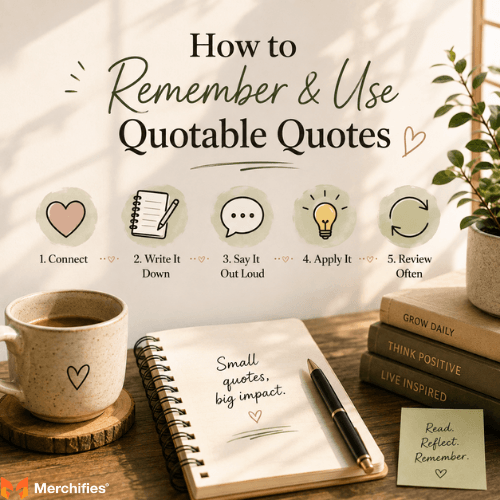
Memorization sticks when you connect a quote to personal experience rather than repeating it in isolation. The following techniques transform passive reading into active retention, ensuring the memorable quotes you collect actually stay with you—and serve you—when you need them. AllMasterHub has tested these strategies across our content curation process, and they translate directly to personal use.
Memorization techniques that work:
Connect the quote to a specific moment in your life. If Hemingway's line about being "strong at the broken places" resonates, link it mentally to a time you rebuilt after setback. The autobiographical anchor creates retrieval cues.
Visualize the speaker. Imagine Churchill delivering his resilience line with characteristic defiance. The mental image adds sensory detail that memory favors over abstract text.
Repeat in context, not rote. Use the quote in conversation, writing, or journaling within 48 hours of encountering it. Application beats repetition for long-term retention.
Write the quote by hand. Handwriting engages motor memory, strengthening encoding beyond what typing or reading alone achieves.
When to use quotes:
Speeches: one to three quotes maximum, placed at opening (attention hook), key transition (credibility anchor), or closing (memorable exit). More than three dilutes impact and signals lazy research.
Writing: use quotes as evidence for your argument, not as filler. Introduce the quote, deliver it, then interpret—never let a quote stand alone without context.
Social media: short, punchy quotes perform best. Pair with clean visuals for shareability.
Daily mantras: choose a single quote for a season. Rotate quarterly rather than daily to allow deep internalization.
Display strategies that reinforce retention: Keeping favorite quotes visible—on a desk print, a mug you use daily, or a piece of apparel you wear—creates passive repetition without active effort. AllMasterHub carries custom quote-based products across categories, from minimalist prints to everyday items, designed specifically for people who want their favorite words within sight. A line that sits in a notes app rarely influences behavior; a line you see every morning while making coffee compounds.
Attribution etiquette matters: Always credit the source. Before sharing, verify accuracy—Quote Investigator is a reliable resource for disputed attributions. Misattributed quotes damage credibility, especially in professional contexts. When in doubt, use "often attributed to" rather than asserting false certainty.
Caution: Quotes should supplement original thought, not replace it. Over-reliance signals intellectual laziness. Use quotes to crystallize an idea you have already developed, not as a substitute for developing ideas in the first place.
If you have assembled a collection of lines that genuinely shape your thinking, consider making one or two visible in your physical environment. Browse AllMasterHub's quote-inspired collections to find prints, mugs, and apparel that turn your favorite quotable quotes into daily companions rather than forgotten bookmarks.
The best quotable quotes earn their place in memory because they compress truth into rhythm, surprise, and brevity. But collecting them is only the first step. Using them—in speeches, in reflection, in visible daily reminders—is what transforms borrowed words into personal wisdom. Choose a single quote from this collection that resonates most, write it somewhere you will see it tomorrow, and let the repetition do its work.
-d4c38c342cdf20ca.jpeg)


-b555fcc6b204c456.jpeg)