-da0801079a650a2e.jpeg)
17 Year Anniversary Quotes: 110+ Funny, Romantic & Furniture Wishes (2026)
Mar, 12 2026

The most powerful Frankenstein quotes capture rejection, ambition, and loneliness in language that still chills readers 200 years later. Explore thematic analysis of Mary Shelley's Gothic masterpiece.
According to Cameron Foster's analysis of Gothic literature, few opening lines land with the devastating precision of the Creature's plea in Mary Shelley's Frankenstein: "I ought to be thy Adam, but I am rather the fallen angel, whom thou drivest from joy for no misdeed." That single sentence, written by an eighteen-year-old in 1816, contains everything that makes Frankenstein quotes endure: Biblical weight, raw emotional anguish, and an accusation that implicates the reader as much as Victor Frankenstein himself. As of 2026, these words trend every October and resurface whenever conversations about artificial intelligence, creator responsibility, or scientific ethics dominate headlines. The quotes that follow organize Shelley's most powerful language by emotional impact rather than plot order, revealing why a novel published in January 1818 still provides the vocabulary for our deepest fears about creation, rejection, and what we owe the beings we bring into existence.
The most memorable Frankenstein quotes fall into distinct emotional categories that Shelley mastered:
The Creature's anguish over rejection and isolation
Victor's hubris and eventual crushing regret
Mutual loneliness and the desperate need for connection
Escalating revenge that destroys creator and creation alike
Atmospheric Gothic prose that invented horror's visual language
Mary Shelley created the modern monster archetype before the genre had a name. When she wrote Frankenstein; or, The Modern Prometheus during a stormy summer at Lake Geneva, she was only eighteen years old. The novel that emerged from that legendary 1816 gathering—where she challenged Percy Shelley, Lord Byron, and John Polidori to each write a ghost story—became the foundation of science fiction, Gothic horror, and the creature feature genre that dominates Halloween culture today.
The famous Frankenstein quotes survive because Shelley captured universal terrors in precise language. Her Creature articulates what every person who has felt unwanted understands instinctively. Victor embodies the hubris that makes brilliant people dangerous. The novel's questions—what do creators owe their creations? what happens when we reject what we've made?—feel more urgent in an age of artificial intelligence than they did in the age of galvanism.
These lines trend seasonally because they provide something rare: literary language accessible enough for Instagram captions yet profound enough for philosophy seminars. Shelley gave us words for feelings we struggle to name ourselves.
The Creature's arc from innocent to murderer represents literature's most devastating portrait of what rejection creates. Shelley builds sympathy methodically through language that makes readers feel the Creature's pain as their own.
"I was benevolent and good; misery made me a fiend. Make me happy, and I shall again be virtuous." This plea contains the novel's moral center. The Creature doesn't claim innocence of his crimes—he claims that cruelty transformed him, and that transformation could be reversed through kindness. The conditional "make me happy" places responsibility squarely on others.
"I am malicious because I am miserable. Am I not shunned and hated by all mankind?" Here Shelley draws the direct causal line. The word "malicious" carries intention, yet "miserable" suggests the intention arose from circumstance, not nature. The rhetorical question forces readers to acknowledge that yes, the Creature has been universally rejected.
"There is love in me the likes of which you've never seen. There is rage in me the likes of which should never escape. If I am not satisfied in the one, I will indulge the other." This ultimatum shows the Creature fully aware of his duality. Love and rage coexist, and which emerges depends entirely on how others treat him. The word "indulge" suggests a choice—but one made under impossible conditions.
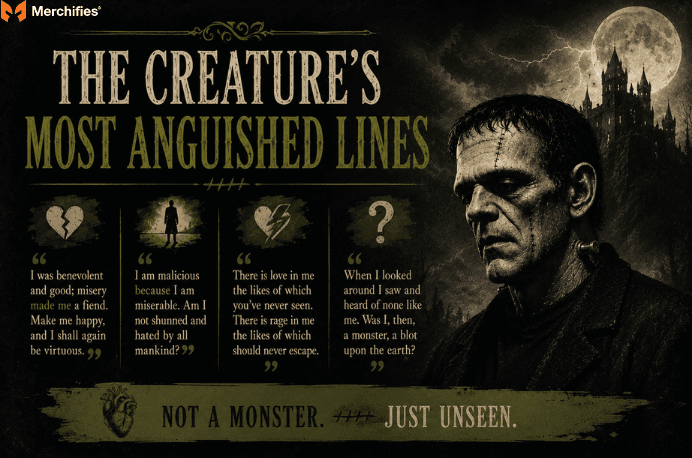
"When I looked around I saw and heard of none like me. Was I, then, a monster, a blot upon the earth, from which all men fled and whom all men disowned?" The questioning form reveals someone searching for identity through others' reactions. He didn't begin thinking himself monstrous—he learned it from universal rejection.
One clarification matters here: the Creature is never named in Shelley's novel. "Frankenstein" refers only to Victor, the scientist who abandoned his creation. This distinction matters because it reveals Shelley's point—the Creature lacks even the basic dignity of a name.
Fans who connect deeply with the Creature's outsider status often want to carry that connection. These themes of rejection and the hunger for acceptance translate powerfully to how people express their literary identities, including through apparel that signals understanding of what it means to feel like the only one of your kind.
Victor's quotes reveal a man who understood his crime only after committing it. Shelley gives him language that oscillates between self-justification and crushing guilt, creating a portrait of genius without wisdom.
"I had worked hard for nearly two years, for the sole purpose of infusing life into an inanimate body. For this I had deprived myself of rest and health." Victor describes his obsession in terms of sacrifice, positioning himself as martyr rather than transgressor. The phrase "infusing life" echoes religious language—Victor saw himself playing God, though he frames it as noble pursuit.
"Learn from me, if not by my precepts, at least by my example, how dangerous is the acquirement of knowledge." This warning from the novel's frame narrative positions Victor as cautionary tale. Yet the structure reveals his blindness: he warns against knowledge while demonstrating that his real failure was abandonment, not discovery.
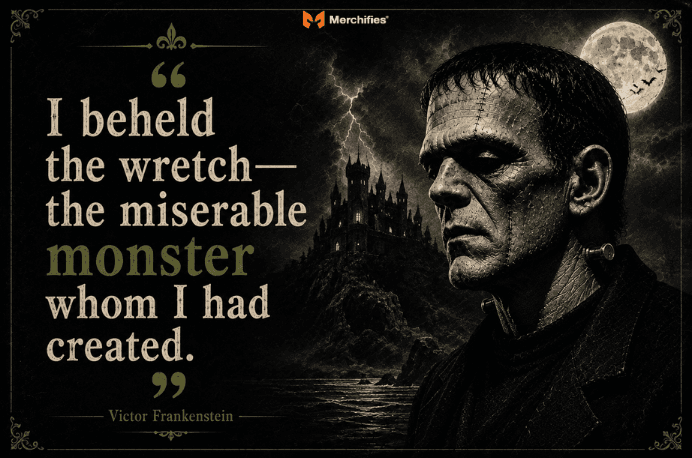
"I beheld the wretch—the miserable monster whom I had created." The shift from "creation" to "wretch" to "monster" happens in Victor's perception, not in reality. The Creature didn't change between his first breath and Victor's rejection—Victor's language changed because confronting his creation horrified him.
"How can I describe my emotions at this catastrophe, or how delineate the wretch whom with such infinite pains and care I had endeavoured to form?" Victor's self-pity dominates even his confession. He mourns his own "emotions" and "pains" while the Creature lies abandoned. This narcissism defines Victor more than any single act.
"I, the miserable and the abandoned, am an abortion, to be spurned at, and kicked, and trampled on." In a moment of terrible irony, Victor uses the same language of rejection that the Creature used. By the novel's end, creator and creation speak the same vocabulary of suffering—evidence that Victor's abandonment destroyed them both.
Scholars note differences between the 1818 and 1831 editions of Frankenstein, with Shelley adding more religious language and fatalistic phrasing in the later version. Both editions capture Victor's essential failure: he possessed the brilliance to create life but not the character to nurture it.
Shelley's exploration of isolation transcends the horror genre to address universal human need. Both Victor and the Creature suffer from loneliness, though their suffering takes different forms—Victor chooses isolation while the Creature has it imposed.
"I am alone and miserable; man will not associate with me." The Creature's statement of fact carries more weight than any plea. He doesn't ask for pity; he reports reality. The semicolon creates causation: his misery flows directly from isolation.
"I desire the company of a man who could sympathize with me, whose eyes would reply to mine." This comes from Walton, the explorer who frames the novel, expressing the same yearning the Creature later articulates. Shelley suggests that loneliness defines the human condition—the Creature simply experiences an extreme version of what everyone feels.
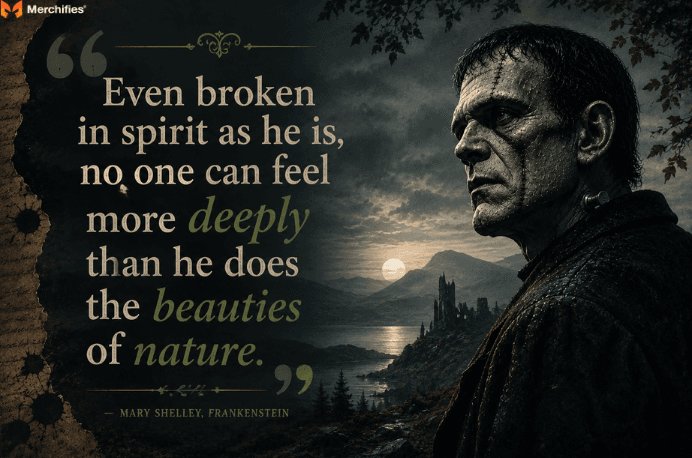
"Even broken in spirit as he is, no one can feel more deeply than he does the beauties of nature." Victor's appreciation of natural beauty offers no comfort because beauty cannot substitute for connection. Shelley shows that aesthetic sensitivity intensifies rather than alleviates loneliness.
"Of my creation and creator I was absolutely ignorant, but I knew that I possessed no money, no friends, no kind of property." The Creature lists what he lacks in social terms. His ignorance about his origins matters less than his awareness of social exclusion. What wounds him isn't philosophical uncertainty but practical rejection.
As Cameron Foster notes, these introspective quotes resonate powerfully for Halloween captions and literary posts because they articulate feelings that most people have experienced but struggle to express. The Creature gives voice to anyone who has felt like the only one of their kind—and October, with its celebration of the strange and the outsider, provides natural permission to share that identification.
The spiral into mutual vengeance gives Frankenstein its horror-genre power. These are the lines that inspired a century of monster movies, transforming philosophical novel into cultural icon.
"I shall be with you on your wedding night." This threat, delivered after Victor destroys the Creature's potential companion, became one of literature's most chilling promises. The Creature could have threatened immediate violence; instead, he chose to make Victor live with dread. The psychological sophistication of delayed revenge distinguishes Shelley's monster from later imitations.
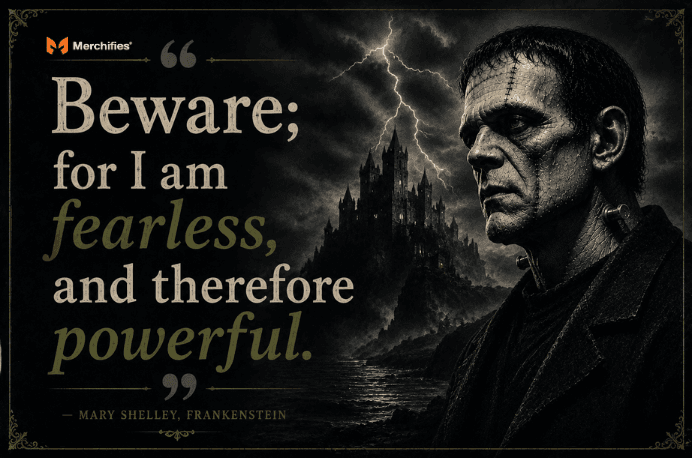
"Beware; for I am fearless, and therefore powerful." The logic here inverts conventional wisdom. We assume the powerful become fearless; the Creature claims that fearlessness itself creates power. Someone with nothing left to lose cannot be controlled through threat.
"You are my creator, but I am your master; obey!" This inversion of the expected power dynamic shows the Creature's evolution from pleading supplicant to commanding force. The semicolon separates fact ("you are my creator") from consequence ("I am your master"), making the power shift feel inevitable.
"If I cannot inspire love, I will cause fear." The Creature explicitly states the choice Victor's rejection forced. This isn't a character choosing evil—it's someone denied option A selecting option B. Shelley makes readers ask whether they would choose differently under identical circumstances.
These revenge quotes defined the horror genre's visual and narrative vocabulary. Every monster that stalks through darkness, every creature that pursues its creator, every villain who justifies destruction through prior rejection draws from Shelley's template. She didn't just write a novel—she wrote the source code for two centuries of horror storytelling.
Shelley's descriptive prose established Gothic horror's visual language before cinema existed. Her settings don't merely backdrop the action—they amplify emotional states and foreshadow catastrophe.
"It was on a dreary night of November that I beheld the accomplishment of my toils." The seasonal specificity matters. November sits at the threshold between autumn's decay and winter's death—the perfect moment for unnatural creation. Shelley chose "dreary" over "dark" because dreariness implies duration, a sustained mood rather than temporary condition.
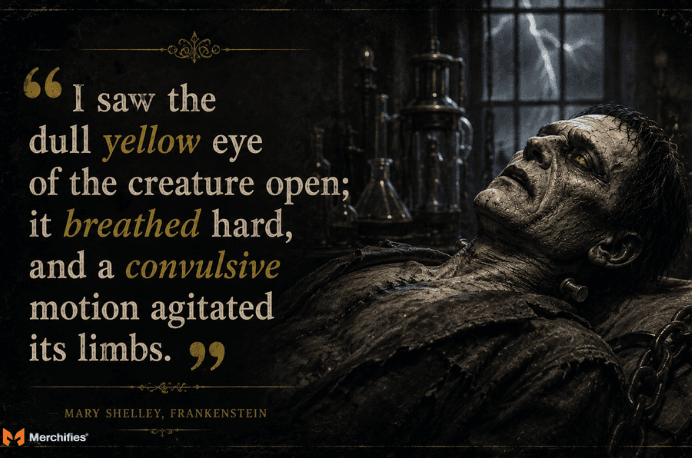
"I saw the dull yellow eye of the creature open; it breathed hard, and a convulsive motion agitated its limbs." This moment of animation terrifies through precision. Not glowing eyes or supernatural light—just "dull yellow," the color of jaundice or decay. The "convulsive motion" suggests something mechanical, not living.
"The rain was pouring in torrents, and thick mists hid the summits of the mountains." Shelley repeatedly uses Alpine weather to externalize internal states. Mountains hidden by mist suggest truths obscured; torrential rain suggests overwhelming emotion. The Romantic movement's reverence for sublime nature finds perfect expression in her environmental writing.
"The immense mountains and precipices that overhung me on every side, the sound of the river raging among the rocks, and the dashing of the waterfalls around spoke of a power mighty as Omnipotence." Nature operates as divine force in these descriptions—beautiful but indifferent to human suffering. Victor seeks consolation in landscapes that offer only scale, not comfort.
These atmospheric quotes set the Gothic mood that Halloween celebration draws upon two centuries later. When decorators create foggy graveyards and lightning-split skies, when filmmakers bathe laboratories in green-tinged shadow, they work from the visual vocabulary Shelley invented on the page.
Practical applications transform literary appreciation into lived experience. Mary Shelley quotes serve purposes ranging from Instagram captions to book club discussions, each context calling for different selections from her work.
For social media captions, the Creature's shorter statements work best: "I am malicious because I am miserable" fits character limits while packing emotional punch. "Beware; for I am fearless, and therefore powerful" provides perfect energy for costume reveals. The atmospheric "dreary night of November" line anchors seasonal posts with literary credibility.
For Halloween party decor, the longer descriptive passages create ambiance. Framed prints of the creation scene description or the Alpine storm passages add sophisticated Gothic elements beyond plastic skeletons. Literary references signal thoughtfulness.
For costume inspiration, the novel provides more than the flat-topped movie monster. Victor's obsessed scientist and the Creature's rejected creation offer character depth for anyone wanting to embody the story rather than just the image. Couples can explore the creator-creation dynamic; groups can represent the full Lake Geneva gathering.
For book club discussions, the quotes about loneliness and connection generate the richest conversation. Questions like "Was the Creature's violence inevitable?" and "What did Victor owe his creation?" never produce consensus, making them ideal for sustained exploration.
Literary apparel makes thoughtful gifts for book lovers and horror fans alike. Unlike mass-market merchandise featuring the Universal Pictures monster, pieces featuring actual Shelley quotes connect to the source material. Merchifies carries Halloween t-shirts featuring Gothic literary themes for fans who want to wear their favorite literature rather than just reference it. The gifting angle works particularly well for English teachers, horror enthusiasts, and anyone who has ever identified with the Creature's outsider experience.
Fans exploring the broader Gothic tradition should also discover our coverage of Edgar Allan Poe quotes , which complement Frankenstein perfectly. Shelley created the monster story; Poe perfected the atmosphere of dread. Together they provide the essential vocabulary of literary horror.
Drawing on Cameron Foster's work with Halloween celebration and literary quotes, the honest trade-off emerges clearly: if you want quotes that sound impressively literary, you may need to sacrifice immediate accessibility for newcomers. You cannot fully have sophisticated allusion and instant recognition without providing the brief contextual bridge that helps unfamiliar readers understand why these two-hundred-year-old words still matter. That bridge is what transforms mere quotation into genuine connection with Shelley's enduring vision.
-d4c38c342cdf20ca.jpeg)


-b555fcc6b204c456.jpeg)