 Worldwide Shipping
 Secure Payments
 Free Return
 Local Support
-da0801079a650a2e.jpeg)
17 Year Anniversary Quotes: 110+ Funny, Romantic & Furniture Wishes (2026)
Mar, 12 2026
Learn how to make DIY Halloween costumes that match your skill level and budget. From no-sew options to intermediate sewing projects, get actionable steps you can start today.
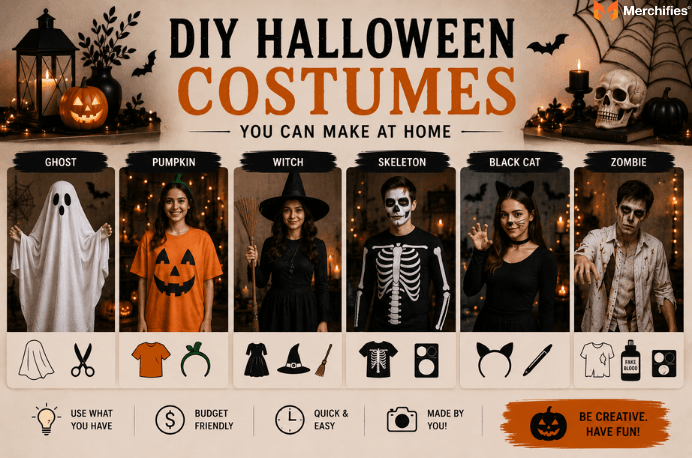
Based on Cameron Foster's research into homemade costume creation, you can make impressive DIY Halloween costumes at home using materials you likely already own — no advanced crafting skills required. The key is matching your costume choice to your actual skill level and available time. As of October 2026, the most successful homemade costumes prioritize simplicity over complexity, using hot glue, safety pins, and fabric tape as reliable alternatives to sewing. Whether you have two weeks or two hours before Halloween night, this guide organizes costume options by difficulty so you can choose one you will actually finish.
The core principle for successful DIY costumes:
Match costume complexity to your honest skill level
Budget 2x the time you think you will need
Test-wear your costume before Halloween night
Keep an emergency repair kit ready
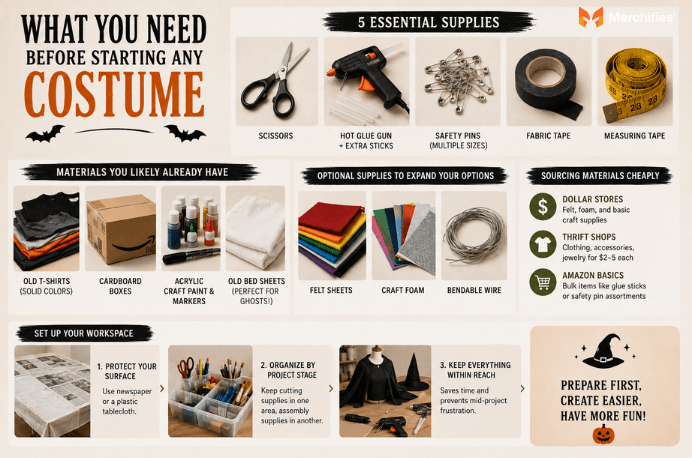
Most DIY Halloween costumes require the same five essential supplies: scissors, a hot glue gun with extra sticks, safety pins in multiple sizes, fabric tape, and a measuring tape. Having these on hand before you start prevents frustrating mid-project trips to the store. You probably own most of these already — check your junk drawer, sewing kit, or craft supplies before buying duplicates.
Materials you likely already have at home include old t-shirts in solid colors, cardboard boxes from recent deliveries, acrylic craft paint, markers, and worn-out bedsheets. That white sheet you were going to donate makes an excellent ghost costume base. The cardboard from your last Amazon order transforms into robot armor or oversized playing cards.
Optional supplies that expand your costume possibilities include felt sheets in various colors, craft foam for dimensional details, and bendable wire for creating structural elements like wings or antennae. These cost $1-3 each at dollar stores and dramatically increase what you can build.
For sourcing materials cheaply, dollar stores carry felt, foam, and basic craft supplies at a fraction of craft store prices. Thrift shops provide clothing bases, costume jewelry, and accessories for $2-5 per piece. Amazon basics work well for bulk items like glue sticks or safety pin assortments when you need quantity.
Set up your workspace before starting any project. Cover your work surface with newspaper or a plastic tablecloth to protect against hot glue drips and paint spills. Organize materials by project stage — cutting supplies in one area, assembly supplies in another. This preparation saves time and prevents the frustration of searching for scissors mid-project.
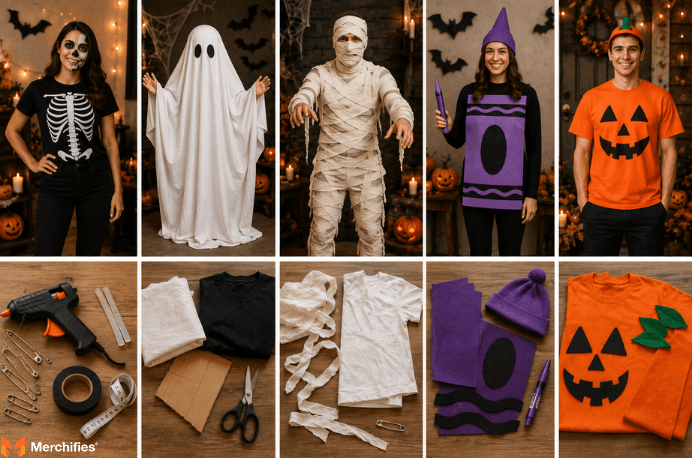
No-sew costumes use hot glue, safety pins, and fabric tape to create fully finished looks without touching a needle and thread. These methods are faster than sewing and often more durable for one-night wear. If you have never made a costume before, start here.
The fastest approach uses a printed tee as your costume foundation. A Halloween-themed t-shirt paired with one accessory creates an instant costume requiring zero construction. A ghost graphic tee plus a sheet cape takes five minutes. A skeleton print shirt with black pants and face paint reads as a complete costume. Merchifies carries Halloween t-shirts in designs from classic monsters to pop culture references — adding one accessory transforms a tee into a finished costume.
The classic ghost costume uses the white sheet method with a critical improvement: put the sheet over your head, mark eye positions with a washable marker while wearing it, then cut the holes. This prevents the common mistake of eye holes that sit on your forehead or cheeks. Total time: 15 minutes. Cost: under $5 if using an existing sheet.
A mummy costume uses torn white fabric strips wrapped and pinned around clothing you are already wearing. Old white t-shirts cut into 2-inch strips work well. Start wrapping at the feet and work upward, pinning every few inches for security. Leave gaps strategically — a fully wrapped mummy cannot bend their arms. Total time: 30 minutes. Cost: under $10.
The crayon costume attaches a felt rectangle to solid-color clothing matching your crayon color. Cut a 12x24 inch rectangle of felt, use a marker to draw the crayon label and details, then pin or tape it to your shirt. A coordinating beanie in the same color completes the tip. Total time: 20 minutes. Cost: under $8.
Starting with simple costumes builds confidence and teaches you which techniques work for your skill level. Many people discover they enjoy costume-making after a successful no-sew project, then attempt slightly more complex builds the following year.
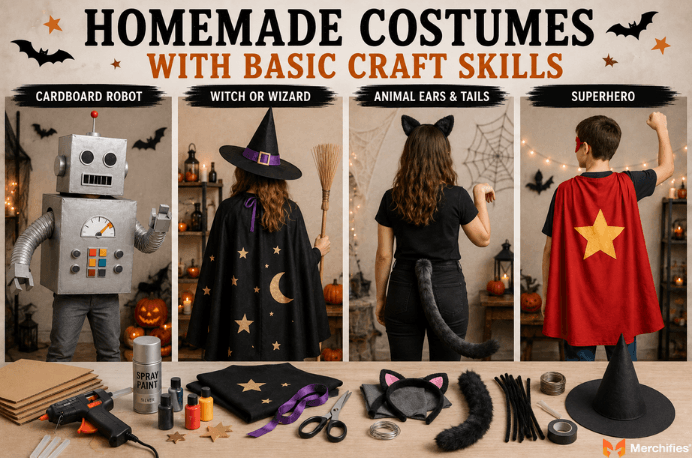
This tier assumes you are comfortable using scissors for precise cuts, operating a hot glue gun without burning yourself, and following visual patterns. These skills separate casual crafters from complete beginners and open up costume options that look genuinely impressive.
The cardboard robot costume requires cutting boxes to fit your torso and head, spray painting them silver or your preferred robot color, and attaching details like painted buttons, duct tape accents, and pipe cleaner antennae. The honest trade-off: cardboard costumes look fantastic in photos but limit mobility and bathroom access. If you plan to wear this for more than two hours, add velcro closures for quick removal. Total time: 2 hours. Cost: under $20.
A witch or wizard costume involves constructing a cape from black fabric and a pointed hat from poster board. For the cape, cut a semicircle of fabric about 60 inches wide, attach a ribbon tie at the neck, and optionally add hot-glued stars or moons. The hat uses poster board rolled into a cone, secured with tape, then attached to a cardboard brim. Paint it black and add embellishments. Total time: 1.5 hours. Cost: under $15.
Animal ears and tails use wire frames covered with felt and attached to a headband or belt. Bend wire into ear shapes, wrap with felt using hot glue to secure, then attach to a plain headband. Tails use the same technique in elongated form, attached to a belt or safety-pinned to pants. Total time: 45 minutes. Cost: under $10.
The most common mistake at this skill level is skipping measurement before cutting. Cardboard cut too small cannot be fixed — you need to start over with new material. Always measure twice against your actual body, not your estimate of your body, before making any cut.
These costumes require straight stitch capability, either by hand or with a sewing machine — if you can sew a straight line and tie a knot, you can complete these projects. Hand sewing takes longer but produces identical results for simple construction.
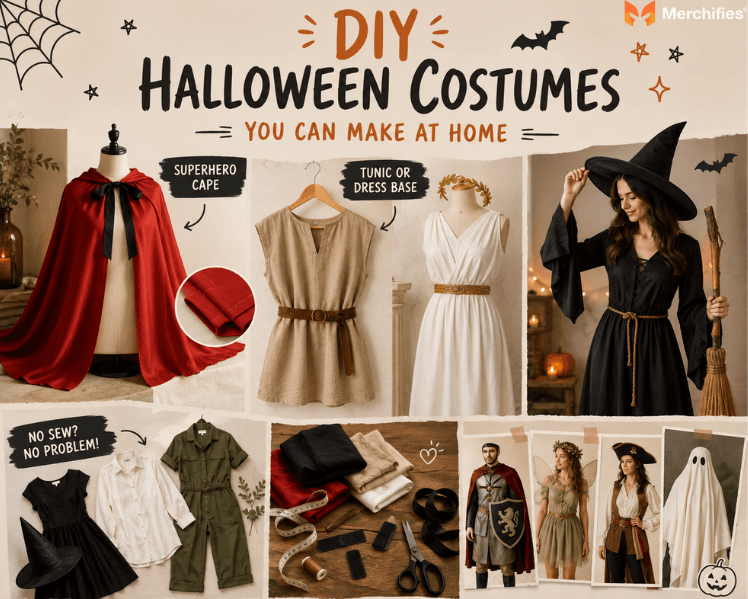
A superhero cape with a proper hem and closure creates a finished look that hot-glued edges cannot match. Cut your fabric into a large semicircle, fold the edges under half an inch, and sew a hem all the way around. Add a ribbon or velcro closure at the neck. The sewn hem prevents fraying and adds structure that makes the cape drape correctly. Total sewing time: 1 hour. Cost: under $15.
A simple tunic or dress base adapts to dozens of character costumes from medieval knights to Greek goddesses to storybook characters. The basic pattern is two rectangles sewn at the shoulders and sides with openings for head and arms. Belt it, accessorize it, and you have the foundation for almost any historical or fantasy character. As Cameron Foster notes, this single base pattern serves as the most versatile piece in any costume-maker's repertoire. Total sewing time: 2-3 hours. Cost: under $25.
When does sewing add real value versus when does hot glue suffice? Sewing creates durability for costumes you will rewear, flexibility for garments that need to move with your body, and a finished appearance for edges that will be visible up close. Hot glue works fine for one-night costumes, rigid accessories, and anything that will be photographed but not closely inspected.
For those without sewing capability, pre-made base garments offer a legitimate alternative. A plain black dress, white button-down shirt, or solid-colored jumpsuit from your closet or a thrift store serves as a modification base rather than a construction starting point. Adding accessories and details to existing garments often produces better results than amateur sewing anyway.
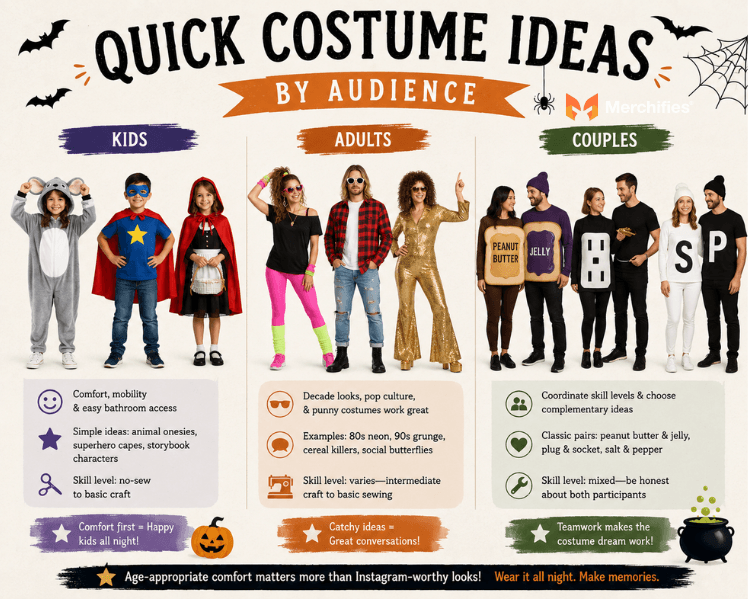
Costume selection depends heavily on who is wearing it — kids, adults, and couples face different practical constraints that affect which costumes actually work.
Kids' costumes must prioritize comfort, mobility, and bathroom access over visual impressiveness. A child wearing an elaborate cardboard costume will be miserable within an hour and may miss trick-or-treating entirely. Effective kid costumes include animal onesie modifications with ear headbands, simple superhero capes over regular clothes, and storybook characters requiring minimal accessories. Skill level for most kid costumes: no-sew to basic craft.
Adult costumes can handle more complex construction because adults tolerate discomfort for fashion and can communicate their needs. Decade-themed looks work well — 80s neon with leg warmers, 90s grunge with flannel, 70s disco with platform shoes. Pop culture references land better with adult audiences who catch the references. Punny costumes like cereal killers or social butterflies require explanation but generate conversation. Skill level for adult costumes: varies by ambition, but intermediate craft to basic sewing is common.
Couples' costumes require coordinating skill levels between partners. If one person sews and one does not, choose costumes where one is complex and one is simple rather than two equally difficult builds. Classic pairs include peanut butter and jelly (brown and purple outfits with felt labels), plug and socket (cardboard construction), and salt and pepper (white and black outfits with S and P labels). Skill level: mixed, requiring honest assessment of both participants.
Age-appropriate comfort matters more than Instagram-worthy appearance. A comfortable costume gets worn all night and generates happy memories. An impressive but uncomfortable costume gets abandoned in the car after thirty minutes.
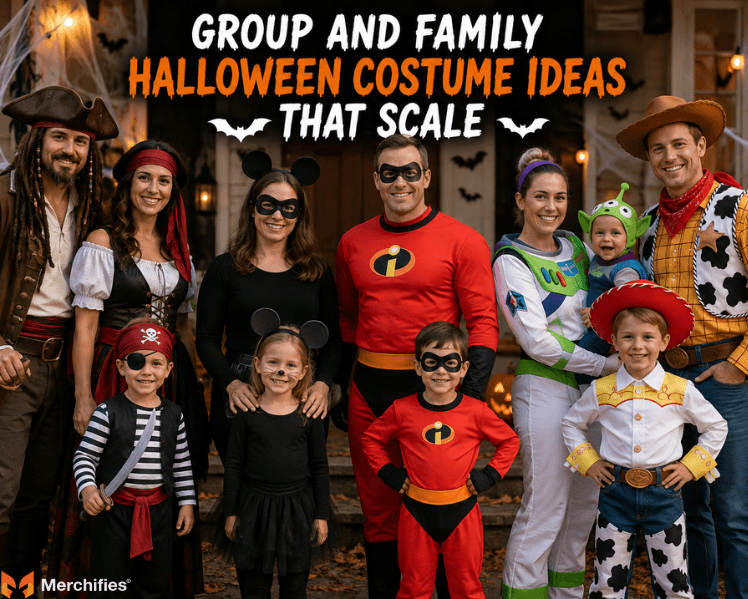
Coordinated group costumes succeed or fail based on whether the group honestly assesses everyone's skill level before choosing a theme. One person who cannot finish their piece ruins the entire coordination.
The crayon box costume uses identical simple construction multiplied across your group. Each person makes the same felt rectangle in a different color. This scales to any group size — three people make a small pack, twenty people make the deluxe box. The visual impact comes from coordination, not individual complexity. Total time per person: 20 minutes. Cost per person: under $10.
Pac-Man and ghosts work because one person makes the complex yellow Pac-Man costume while everyone else makes simple ghost costumes from colored sheets. This acknowledges unequal skill levels within the group while producing a unified theme.
Playing cards use poster board bases that anyone can construct, with face card details adding complexity only for those who want it. The King can be elaborate while the Three of Hearts keeps it simple. Scales to any group size divisible by reasonable deck sizes.
For instant group coordination without individual construction, matching printed shirts with a group name or theme create visual unity with zero crafting required. Custom text tees reading "The [Family Name] Monsters" or "Zombie Response Team" establish group identity while each person adds their own accessory interpretation.
Assign one coordinator to ensure consistency across the group — matching colors, proportions, and completion timeline. Without coordination, you end up with one professional-quality costume and four half-finished ones that undermine the entire concept.
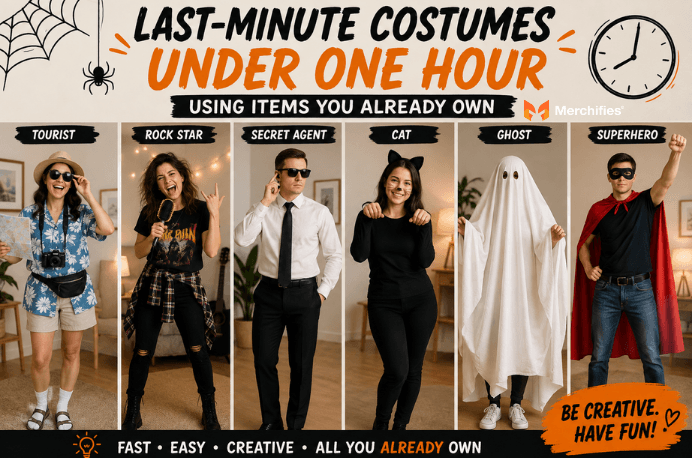
Last-minute costumes differ from no-sew costumes in one critical way: they require zero purchases, using only items already in your closet or home. If Halloween is tonight and the stores are closed, these options save you.
The tourist costume assembles in five minutes from a camera or phone on a lanyard, a Hawaiian shirt or loud patterned top, a fanny pack or crossbody bag, and sunglasses. Add a sun hat if available. Total assembly time: 5 minutes. Cost: free.
Error 404 costume uses a white t-shirt with "Error 404: Costume Not Found" written in black marker. Simple, self-aware, and requires only a marker and any white shirt. Total time: 10 minutes. Cost: free.
A cat costume uses black clothing from your closet, DIY ears made from a headband and felt or cardboard, and whiskers drawn on your face with eyeliner. Add a tail safety-pinned to your pants if you have black fabric or a black belt. Total time: 15 minutes. Cost: free if you own black clothes and eyeliner.
The exhausted parent costume requires pajamas, an empty coffee mug, and messy hair. This costume improves with authenticity — real exhaustion reads better than performance exhaustion. Total time: 2 minutes. Cost: free.
When a themed t-shirt you already own becomes the costume foundation, Halloween becomes dramatically simpler. If you own a band tee, sports jersey, or graphic shirt with any seasonal relevance, building around it with accessories takes minutes rather than hours. This is why owning a few Halloween-themed tees before October provides future last-minute insurance.
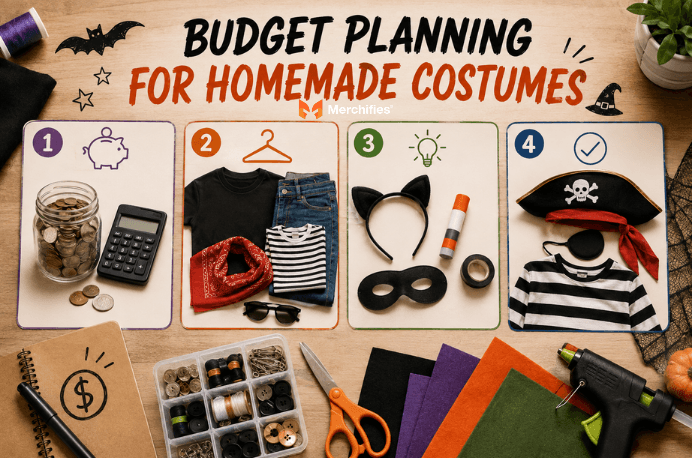
True costume costs include both materials you buy and materials you repurpose, but the ratio between those two determines whether DIY actually saves money.
Budget tier breakdown with example costumes: Under $10 gets you a ghost, mummy, or crayon using household materials and minimal purchases. $10-25 covers a cardboard robot, witch or wizard, or animal costume requiring more specialized materials. $25-50 supports elaborate multi-component costumes like full character recreations requiring fabric, accessories, and specialty items.
Hidden costs to account for include adhesives (hot glue sticks run out faster than expected), paint (spray paint cans cover less than you think), and accessories that "complete" the look (the $8 hat you had to buy). Add 20% to your material estimate for these overlooked items.
When does buying a base item save money versus constructing from scratch? If a plain black dress costs $15 at a thrift store and making one requires $25 in fabric plus four hours of sewing, buying wins. If a specific character shirt costs $40 but printing your own design on a $5 blank tee costs $15 total, DIY wins. Calculate material cost plus your time value before deciding.
Printed costume tees function as budget-smart bases when the math works out. A $15-25 Halloween tee plus $5-10 in accessories (cat ears, cape, face paint) totals $20-35 and produces a finished costume in fifteen minutes. Constructing a similar look from craft supplies often exceeds $40 in materials alone, plus hours of labor. Browse Merchifies Halloween t-shirts — including classic monsters, punny designs, and pop culture references — to find a base that matches your costume concept while protecting your budget.
The most expensive costume mistake is starting too late — complexity determines your timeline, not optimism about your crafting speed.
Realistic timelines by costume complexity: No-sew costumes work on Halloween day with an hour to spare. Craft-level costumes need one week minimum to allow for material acquisition, construction time, and fixing mistakes. Sewing projects need two weeks or more because sewing mistakes require complete restarts, not quick fixes.
Skipping test-wearing guarantees problems on Halloween night. The armholes might be too small. The headpiece might block peripheral vision. The tail might drag on the ground. Wear your complete costume for thirty minutes before the event and make adjustments. This single step prevents most costume disasters.
Overcomplicating first attempts happens when ambition exceeds experience. If you have never made a costume, do not attempt the elaborate dragon armor you saw on Instagram. Start two levels simpler than you think you should. A well-executed simple costume impresses more than a half-finished complex one.
Forgetting comfort creates costumes that look amazing in photos but ruin the night. Consider mobility — can you walk, sit, and dance? Consider bathroom access — can you handle this yourself or do you need help? Consider temperature — indoor parties and outdoor trick-or-treating have different requirements.
Not photographing progress causes problems when you need to troubleshoot or recreate elements. Take photos at each construction stage. If something goes wrong, you can identify exactly where. If your costume is a hit, you can recreate it more easily next year. Drawing on Cameron Foster's work with seasonal celebrations, documentation transforms a one-time project into a repeatable skill you build on annually.
The right costume matches your skill level to your timeline to your budget. Merchifies offers Halloween tees and graphic apparel — from spooky classics to funny seasonal designs — that serve as instant costume foundations or no-effort alternatives when DIY does not fit your situation. Browse the collection to find the style that matches your Halloween plans.
-d4c38c342cdf20ca.jpeg)


-b555fcc6b204c456.jpeg)